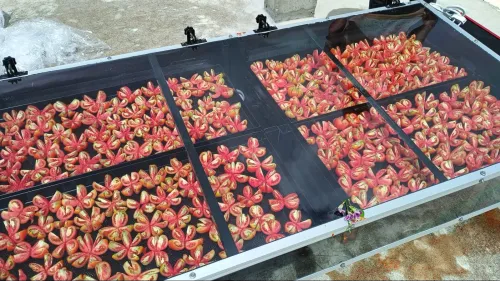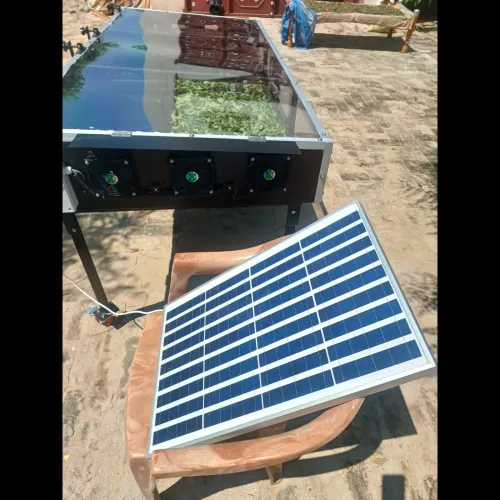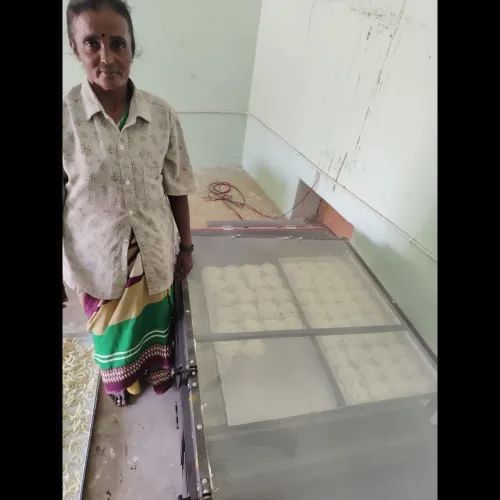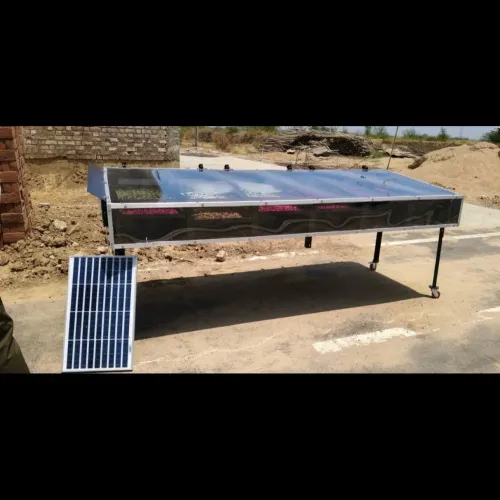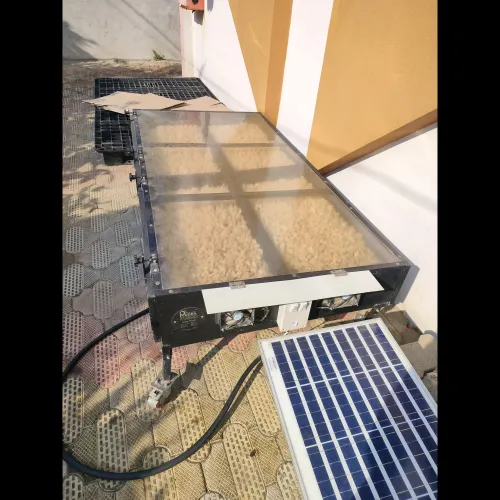
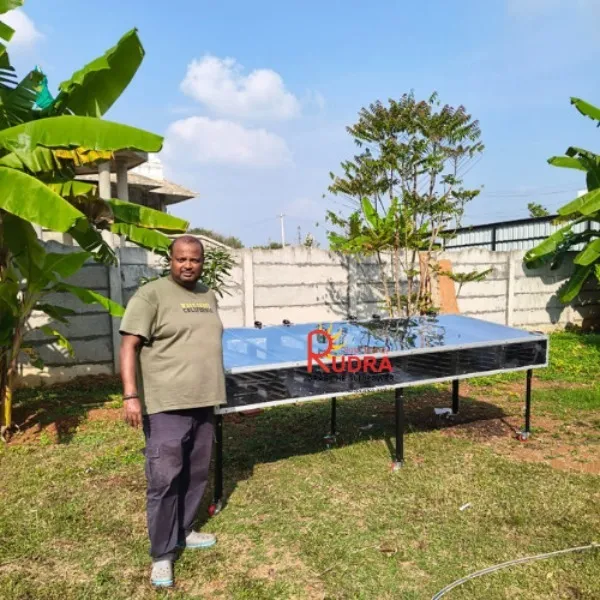
Kasganj lies in Uttar Pradesh’s South-Western Semi-Arid Plain Zone, where agricultural processing must account for hot summers, changing humidity and seasonal weather conditions. The district’s farming profile includes pearl millet, maize, rice, wheat, rapeseed, mustard, potato, vegetable pea, garlic, onion and flowers.
A Rudra Solar Dryer in Kasganj can be evaluated by farmers, FPOs, SHGs, seed producers and food-processing enterprises that want an enclosed system for reducing moisture from suitable agricultural materials. However, grains, oilseeds, vegetables, flowers and spices require different dryer configurations and operating procedures.
Kasganj’s officially recognised ODOP product is Zari-Zardozi. Solar drying should therefore be presented as a separate agricultural and food-processing opportunity, not incorrectly described as Kasganj’s ODOP industry.
Why Does Kasganj Need Commodity-Specific Solar Drying?
Kasganj experiences wide seasonal changes in temperature and relative humidity. These conditions can affect available solar energy, drying-air temperature, moisture-removal rate and processing duration.
High outdoor temperature does not automatically guarantee correct drying. Excessive heat can be unsuitable for temperature-sensitive flowers, herbs and prepared vegetables, while inadequate airflow can slow moisture removal even when the drying chamber feels hot.
Effective solar drying depends on the interaction between:
- Commodity
- Initial moisture
- Required final moisture
- Piece or particle size
- Product thickness
- Tray loading
- Loading depth
- Airflow
- Ambient temperature
- Relative humidity
- Available solar energy
- Dryer design
An enclosed Rudra Solar Dryer can reduce direct exposure to dust, insects, birds and uncontrolled outdoor contact compared with open-sun drying. Organised tray loading and forced airflow can support a more manageable drying process.
This does not mean that one fixed temperature or drying duration will work throughout the year. A batch processed during hot, dry weather may behave differently from a batch processed during humid or cloudy conditions.
Drying progress should therefore be assessed against the required final moisture or product condition rather than only against a fixed number of hours.
Which Kasganj Commodities Can Be Evaluated for Solar Drying?
Different Kasganj commodities create different processing requirements. Suitable applications can be evaluated for:
- Prepared garlic
- Sliced onion
- Potato slices
- Vegetable peas
- Selected vegetables
- Appropriate flowers
- Mustard and rapeseed
- Pearl millet and maize
- Wheat and rice
- Selected seeds and pulses
- Herbs and spices
- Other suitable agricultural materials
Garlic and onion
Garlic and onion can be evaluated for dried slices, flakes or suitable raw material for further processing.
Preparation may involve:
- Sorting
- Cleaning
- Peeling
- Cutting or slicing
- Size standardisation
- Suitable pre-treatment where required
These preparation stages are separate from drying. The dryer performs moisture reduction after the material has been properly prepared.
Garlic cloves and thin garlic slices should not be expected to dry at the same rate. Similarly, thick onion pieces, thin slices and separated layers can require different tray areas and drying durations.
Potato and vegetable pea
Potato drying may require washing, peeling, slicing and appropriate pre-treatment before the material is loaded. A solar dryer does not automatically manufacture potato chips, flakes or powder. These are separate product-development and downstream-processing stages.
Vegetable peas and other vegetables can also require commodity-specific preparation. Fresh produce with different maturity, moisture and piece size should not be mixed into one uncontrolled batch.
Flowers
Flowers can be sensitive to temperature, airflow and handling. The correct procedure depends on whether the intended product is a decorative dried flower, botanical ingredient or another suitable value-added material.
Materials intended for food or beverage use require appropriate raw-material selection, hygienic processing and compliance with applicable food-safety requirements.
Millet, maize, wheat, mustard and seeds
Kasganj’s pearl millet, maize, wheat, mustard and other field crops may create moisture-management requirements before storage or further processing.
However, a high-volume grain or oilseed application should not automatically be assigned to a small tray dryer. System selection must account for:
- Daily fresh or incoming quantity
- Bulk density
- Loading depth
- Required throughput
- Initial moisture
- Safe target moisture
- Airflow resistance
- Available drying area
Mustard, millet, maize and wheat should also not be processed using the same settings as garlic, onion or flowers.
How Should Buyers Choose a Rudra Solar Dryer in Kasganj?
A buyer should select the dryer according to the proposed product and daily processing requirement—not simply according to a stated kilogram capacity.
Two materials with the same fresh weight can occupy very different amounts of tray space. For example, 50 kg of flowers, sliced onion, mustard seed and prepared potato may require substantially different usable drying areas and loading depths.
A practical capacity assessment should consider:
Fresh Input Weight + Material Volume + Usable Tray Area + Loading Depth + Moisture to Be Removed + Daily Throughput
Before requesting a model or quotation, Kasganj buyers should provide:
- Commodity name
- Fresh quantity per batch or day
- Product form before drying
- Approximate piece thickness
- Initial and target moisture where known
- Required batches per day
- Seasonal or year-round operation
- Available installation space
- Solar-only or hybrid requirement
- Preferred tray/contact material
- Intended final product
- Current drying method
The solar dryer price in Kasganj can vary according to capacity, drying area, tray quantity, airflow arrangement, material of construction, optional hybrid support, monitoring requirements, transportation and installation.
Where several commodities will use the same suitable system, they should be processed in separate batches. Operating conditions, tray loading and cleaning requirements should be reviewed whenever the product changes.
Drying is also not the final stage. Suitable cooling, final-moisture assessment, grading, packaging and protection from re-wetting are important after the batch leaves the dryer.
For evaluating a Rudra Solar Dryer in Kasganj, share the commodity, prepared daily quantity, processing location, intended final product, available space and current drying method. Rudra Solar Energy can then assess an application-appropriate configuration for the proposed requirement.
Keywords