Balrampur has a diversified agricultural base where vegetable production and field crops both contribute to local farming activity. Krishi Vigyan Kendra, Balrampur specifically demonstrates tomato, bottle gourd, brinjal and chilli to promote vegetable production in the district, while also organising cluster demonstrations for pulses and oilseed crops.
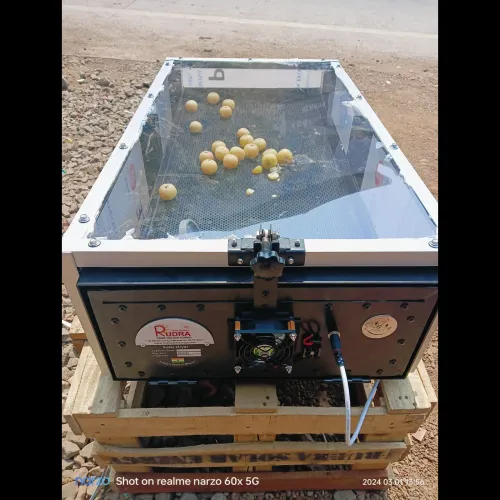
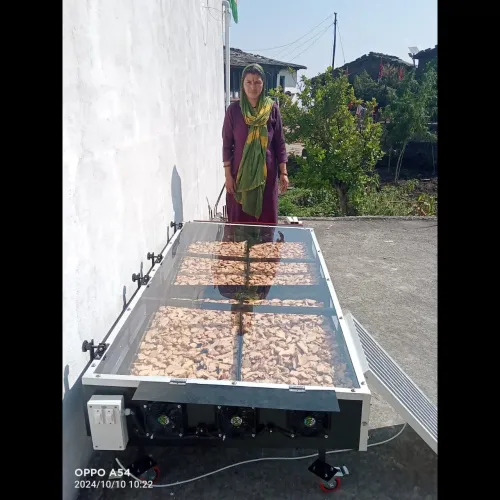
For farmers, FPOs, SHGs and food-processing businesses handling suitable vegetables and other agricultural produce, a solar dryer in Balrampur can provide an enclosed, tray-based system for organised moisture reduction.
Balrampur’s strongest processing opportunity is not simply “vegetable drying” as one broad category. Tomato, bottle gourd, brinjal and chilli differ greatly in moisture content, structure, preparation and tray-loading behaviour. A technically suitable solar dryer should therefore be selected and operated according to the actual commodity.
Tomato Processing Requires Control Over High Initial Moisture
Tomato is one of the vegetables specifically demonstrated by KVK Balrampur.
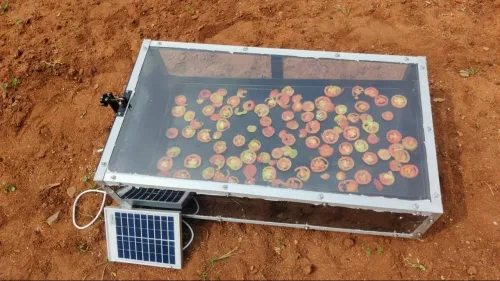
Fresh tomato contains substantial moisture. When tomato is intended for dehydration, preparation has a direct effect on the drying process.
Depending on the final product, suitable preparation may include sorting, washing and cutting or slicing before the material enters the dryer.
A solar dryer for tomato should then be operated with attention to:
- slice thickness
- initial moisture
- tray loading
- usable surface area
- airflow
- chamber temperature
- ambient humidity
- required final moisture condition
Thick and thin tomato pieces within the same batch may not lose moisture at the same rate.
For this reason, preparation consistency can matter just as much as the nominal capacity of the dryer.
Bottle Gourd Gives Balrampur a Distinct Solar Dryer Application
Bottle gourd creates a more distinctive processing angle for Balrampur than repeating the same potato or chilli discussion used across many Uttar Pradesh districts.
KVK Balrampur specifically includes bottle gourd among the vegetables it demonstrates in the district.
Bottle gourd has high water content, so where it is suitable for dehydration, the processor should first define the intended product form.
Prepared slices or pieces should be distributed across the trays so that moving heated air can contact the material effectively.
A solar vegetable dryer does not simply heat the product. As moisture leaves the bottle gourd, humid air must be carried away from the loaded trays.
If trays are overloaded or pieces overlap excessively, air movement around the product can be restricted.
For bottle gourd processing, buyers should therefore think about:
prepared product size + tray surface + loading density + airflow + moisture removal.
This makes tray utilisation an important equipment-selection factor.
Brinjal Needs a Different Loading Strategy
Brinjal is another vegetable demonstrated through Balrampur KVK programmes.
Where brinjal is intended for a dried or dehydrated application, the product may require appropriate preparation before loading.
Brinjal pieces differ from tomato and bottle gourd in physical structure, surface characteristics and thickness.
The same tray-loading pattern should therefore not automatically be used for all three.
A processor handling brinjal should consider:
- uniform preparation
- product thickness
- spacing between pieces
- airflow across the trays
- operating temperature
- desired final moisture
This is one reason a multi-product dryer should provide operational flexibility rather than rely on one standard drying formula.
Chilli Creates an Additional Spice-Processing Opportunity
Chilli is also among the vegetables demonstrated by KVK Balrampur.
Chilli has a very different drying behaviour from high-moisture tomato or bottle gourd.
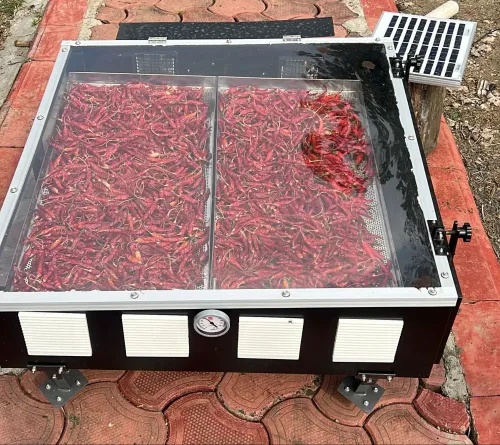
For suitable chilli processing, a solar chilli dryer should allow air to move through or around the loaded product without excessive piling.
Useful operating considerations include:
variety, maturity, fresh moisture, tray depth, airflow, humidity and desired final condition.
A solar dryer can provide an enclosed environment for moisture reduction, but final results still depend on correct preparation and operating conditions.
Why Balrampur Processors Should Compare Tray Area, Not Only Capacity
A common buyer question is:
“How many kilograms can the solar dryer handle?”
That is important, but it does not fully explain processing capability.
For example, 25 kg of sliced tomato can occupy trays very differently from 25 kg of chilli or another denser agricultural product.
A more useful equipment comparison includes:
Batch Capacity — How much fresh material is expected?
Usable Tray Area — How much surface is actually available for product distribution?
Loading Density — Can the product be arranged without blocking air movement?
Airflow — How will heated air reach different trays?
Production Frequency — How many batches are required during peak season?
This buyer-focused information helps an FPO or processor select equipment based on actual workflow rather than only marketing numbers.
Pulses and Oilseeds Need a Different Moisture-Management Approach
Balrampur KVK also conducts cluster demonstrations aimed at promoting pulses and oilseed crops.
This does not mean pulse and oilseed batches should be treated like fruits or vegetables.
Seeds and pulses have different bulk density, initial moisture and storage requirements.
Where a solar dryer is technically appropriate for moisture management, the processor should evaluate the commodity-specific moisture target and operating temperature.
The objective is controlled moisture reduction—not exposing every agricultural commodity to the highest possible chamber temperature.
This distinction strengthens the usefulness of a solar dryer for agricultural products in Balrampur where buyers may handle more than one type of farm produce.
Multi-Product Solar Dryer for Seasonal Processing
A Balrampur FPO, SHG or rural enterprise may handle different products during different parts of the year.
A suitably configured solar dryer may potentially support separate batches of:
- tomato
- bottle gourd
- brinjal
- chilli
- suitable vegetables
- herbs
- selected agricultural products
However, multi-product does not mean multi-product-at-the-same-setting.
Whenever the commodity changes, the operator may need to reconsider:
preparation, tray loading, airflow, temperature, drying endpoint and cleaning requirements.
This operational flexibility can be more valuable to a rural processing business than equipment designed around one crop alone.
Solar Heat Is Only One Part of Effective Drying
One of the most important technical points for Balrampur buyers is that heat alone does not determine drying performance.
Moisture leaving the product enters the air inside the drying chamber.
That humid air needs a route out of the chamber so new drying air can continue to absorb moisture.
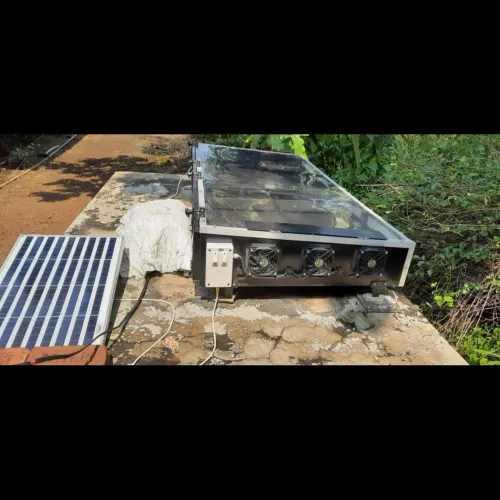
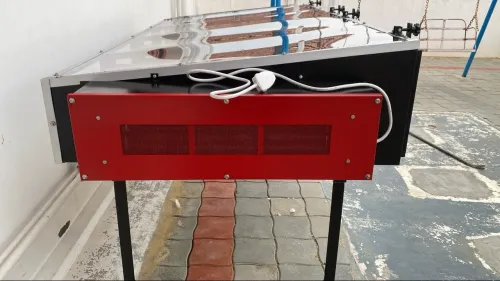
Forced-convection solar dryers use fan-driven air movement to support circulation through the drying system; Raheja also promotes forced convection in its Sahaj product, showing that airflow is a major competitive technical feature in this category.
For Rudra, the opportunity is to explain this more deeply:
solar heat creates drying potential; airflow carries released moisture away.
Tray loading, air distribution and exhaust are therefore part of the complete drying process.
What Happens During Cloudy or Humid Conditions?
Solar drying performance changes with weather.
Reduced solar radiation can reduce available thermal energy, while high relative humidity can decrease the ability of incoming air to accept additional moisture.
An enclosed dryer protects the loaded material from direct rainfall, but it should not be described as completely weather-independent.
Businesses that need greater production flexibility may evaluate a hybrid solar dryer or suitable backup-assisted configuration according to:
- operating season
- batch requirement
- product type
- production schedule
- acceptable drying window
This is more technically useful than promising identical performance every day of the year.
Solar Dryer Price in Balrampur: What Determines the Quote?
There is no single useful solar dryer price in Balrampur for every farm or processing business.
The final configuration can vary according to:
- required batch capacity
- commodity
- number and size of trays
- usable tray area
- airflow arrangement
- chamber construction
- solar-only or hybrid configuration
- monitoring requirements
- installation needs
- customisation
A small vegetable-processing SHG may have a very different requirement from an FPO handling regular commercial batches.
Before asking for a quotation, a buyer should ideally provide:
Main commodity: tomato, bottle gourd, chilli or something else?
Fresh quantity: kilograms per batch/day.
Product form: whole, sliced, chopped or otherwise prepared.
Production period: which months require the most processing?
Current drying method: open sun or another process?
Backup requirement: is solar-only operation acceptable?
These inputs help a manufacturer recommend equipment according to the real application.
Solar Dryer for Balrampur Farmers, FPOs and Food Businesses
Potential users of a solar dryer in Balrampur can include:
farmers, vegetable growers, FPOs, SHGs, agricultural cooperatives, rural entrepreneurs, food-processing MSMEs and institutional agriculture projects.
Each buyer should evaluate equipment according to normal product flow.
An SHG processing occasional tomato batches should not automatically purchase the same configuration as an organisation aggregating vegetables from many farmers.
The right starting point is therefore:
product → quantity → preparation → tray requirement → operating schedule → dryer configuration.
Rudra Solar Energy for Solar Dryer Requirements in Balrampur
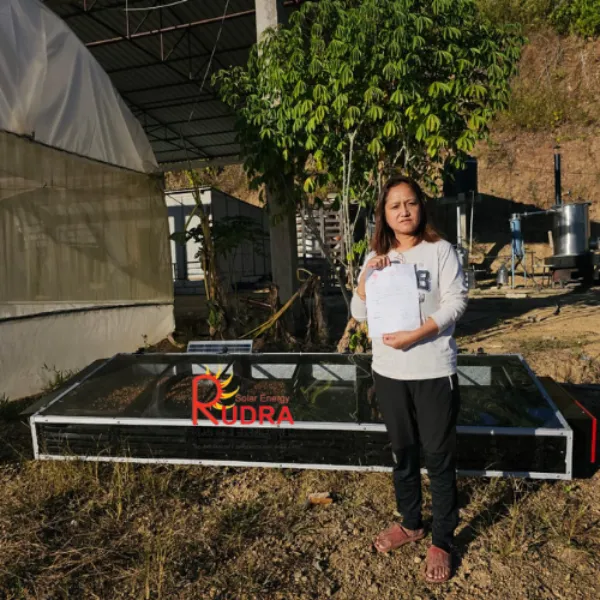
Rudra Solar Energy provides solar dryer systems for agricultural and food-processing applications.
Depending on the relevant model or project configuration, systems may include enclosed chambers, food-contact trays, controlled or forced airflow, solar-powered DC fans and optional hybrid or backup arrangements.
For Balrampur, the system can be evaluated around the actual local application rather than a generic state-level crop list.
A tomato processor may require substantial tray surface for prepared slices.
A bottle-gourd processor may prioritise controlled loading of high-moisture pieces.
A chilli processor may need a different product depth and airflow approach.
This commodity-specific engineering helps make the equipment-selection process more useful for businesses searching for a solar dryer in Balrampur, solar dryer manufacturer in Balrampur or a suitable solar food dehydrator for vegetable processing.
Planning tomato, bottle gourd, brinjal, chilli or other farm-produce processing in Balrampur? Share your commodity, fresh quantity and production requirement with Rudra Solar Energy to discuss an appropriate solar dryer configuration.
Keywords
solar dryer in Balrampur, solar dryer Balrampur, solar dryer manufacturer in Balrampur, solar dryer Uttar Pradesh, solar dryer for tomato, tomato drying machine, solar vegetable dryer, solar dryer for bottle gourd, bottle gourd drying machine, solar dryer for brinjal, solar chilli dryer, solar food dehydrator, solar food dryer, solar dryer for agricultural products, commercial solar dryer, hybrid solar dryer, solar dryer price in Balrampur, solar dehydrator machine, Rudra Solar Energy
Keywords