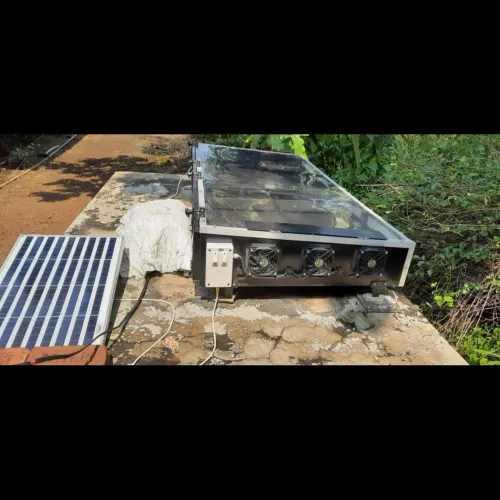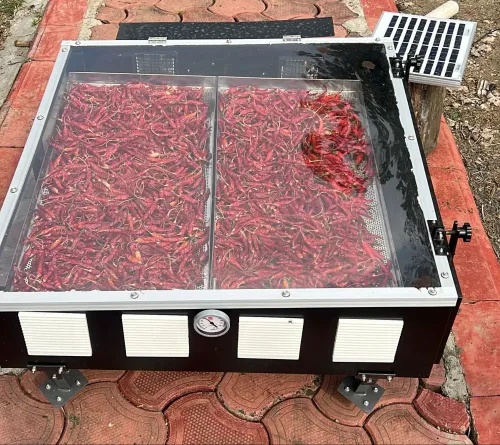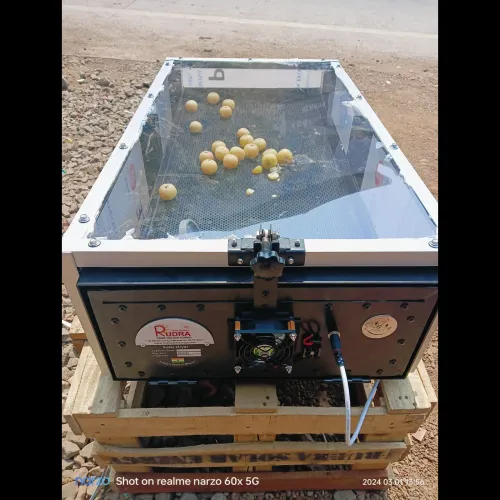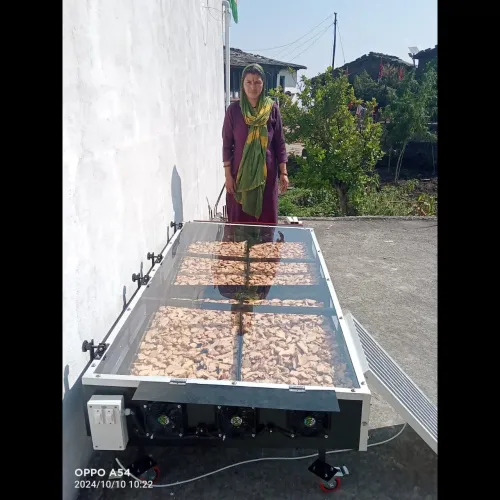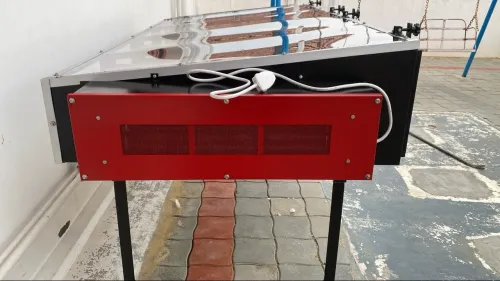
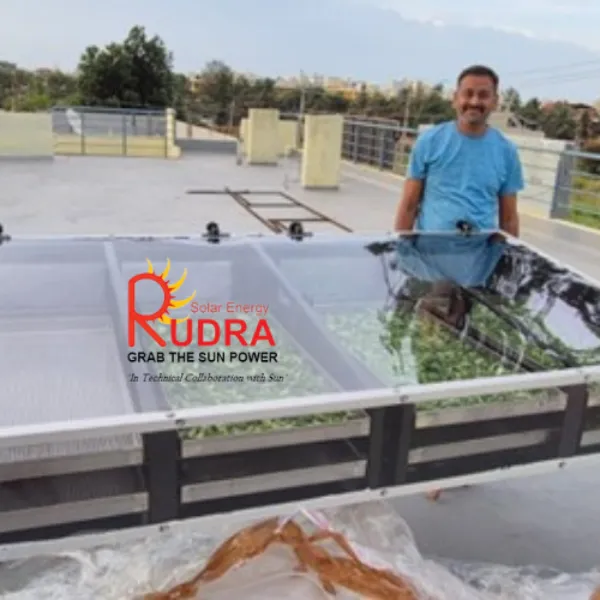
Ghazipur is one of eastern Uttar Pradesh’s agriculturally important districts, with fertile alluvial plains supporting rice, wheat, vegetables and horticultural crops. For food processing, onion deserves particular attention because the Government of India’s PMFME One District One Product framework identifies Onion-Based Products as Ghazipur’s ODOP. The district is also known for fragrant rose cultivation and rose-water production, creating additional opportunities for suitable flower and botanical processing. For farmers, FPOs, SHGs and agro-processing businesses, a Solar Dryer in Ghazipur can provide an enclosed tray-based environment for controlled moisture reduction from onion, vegetables, spices, herbs, flowers and other compatible agricultural materials.
Why is solar drying relevant for Ghazipur’s agricultural sector?
Agriculture forms a major part of Ghazipur’s economy. The official district profile describes the area as part of the fertile Mid-Gangetic plain and reports a large share of district land under agricultural use.
Solar drying can be useful where farmers or processors want to introduce a controlled moisture-removal stage into a value-addition process.
Potential users can include:
Onion Growers
Vegetable Farmers
FPOs and FPCs
SHGs
Farmer Cooperatives
Food-Processing MSMEs
Spice Processors
Herbal Businesses
Flower Processors
Agricultural Entrepreneurs
Ghazipur also has documented FPO activity, including farmer-producer organisations around Mohammadabad, strengthening the relevance of group-based processing and value addition.
Why is onion an important solar drying application in Ghazipur?
Onion is Ghazipur’s official ODOP food-processing product, making it one of the strongest local commodities around which a value-addition page can be built.
Depending on the intended product, suitable onions may undergo separate stages such as:
Sorting
Cleaning
Peeling
Slicing
Drying
Grinding Where Powder Is Required
Packaging
The Solar Dryer performs the moisture-removal stage.
Drying onion can support subsequent preparation of suitable products such as dried slices, flakes or material intended for further grinding.
Can onion flakes be produced using a Solar Dryer?
A Solar Dryer can dry appropriately prepared onion slices that may later form part of an onion-flake production process.
However, the complete process involves more than the dryer itself.
Typical operations may include:
Raw Onion Selection
Cleaning
Peeling
Uniform Slicing
Suitable Pretreatment Where Required
Drying
Cooling
Grading
Packaging
The final specification should depend on the intended buyer or food-processing application.
Can a Solar Dryer directly make onion powder?
No. Drying and powder manufacturing are separate operations.
A Solar Dryer removes moisture from prepared onion.
Producing onion powder normally requires additional steps such as:
Cooling
Grinding or Milling
Sieving
Quality Assessment
Packaging
This distinction is important because Ghazipur’s ODOP is onion-based products, not simply raw onion drying. A solar dryer can be one useful machine within that wider processing chain.
Which other crops can be dried using a Solar Dryer in Ghazipur?
Depending on availability, preparation and final use, suitable applications can include:
Onion
Garlic
Chilli
Ginger
Turmeric
Selected Vegetables
Prepared Fruits
Herbs
Leafy Materials
Rose Petals
Other Suitable Flowers
Selected Seeds
Suitable Grain Applications
Other Compatible Agricultural Produce
The district administration officially describes Ghazipur as producing rice, wheat, vegetables and horticultural products, while also highlighting rose cultivation.
The dryer should nevertheless be selected around the actual commodity rather than assuming every crop behaves identically.
Can garlic, chilli, ginger and turmeric be dried in the same system?
A properly selected multipurpose solar dryer may process different compatible products in separate batches.
But the operating process should change according to the material.
Onion, garlic, chilli, ginger and turmeric differ in:
Initial Moisture
Physical Structure
Bulk Density
Preparation
Slice or Particle Thickness
Tray Loading
Airflow Requirement
Temperature Sensitivity
Target Final Moisture
Cleaning between different products should also be appropriate for the intended food-processing use.
Is Ghazipur’s rose cultivation relevant to solar drying?
Yes, for appropriate dried-flower or petal applications.
Ghazipur’s official district profile specifically identifies fragrant rose cultivation and rose-water production as part of the district’s agricultural identity.
Suitable rose petals may be dried where the required end product is a dried floral or botanical material.
However, there is an important technical distinction:
Solar drying does not produce rose water.
Rose-water production generally requires a separate extraction or distillation process.
A Solar Dryer performs moisture reduction only.
This allows the Ghazipur page to cover the district’s famous rose identity without incorrectly claiming that a dryer performs distillation.
What should be considered when drying rose petals?
Flowers are more delicate than many vegetables.
Important variables can include:
Flower Freshness
Petal Thickness
Loading Depth
Airflow
Temperature
Drying Duration
Desired Colour
Desired Aroma
Target Final Moisture
Post-Drying Storage
The highest temperature a dryer can generate should not automatically be used for flowers.
Gentler drying conditions may be more appropriate depending on the intended product.
How does a Solar Dryer work?
Prepared agricultural material is placed on trays inside an enclosed drying chamber.
Solar radiation supplies thermal energy. As the product warms, moisture moves from the material into the surrounding air.
Air circulation then helps carry the moisture-bearing air away.
The practical drying process therefore depends on:
Solar Heat + Airflow + Tray Area + Correct Loading + Moisture Removal
A high chamber temperature alone does not guarantee effective drying.
Why is airflow important when drying onion?
Onion contains substantial moisture.
As moisture leaves the onion slices, the surrounding air becomes more humid.
That moisture-bearing air needs to move away from the product so further moisture can continue to escape.
Useful airflow therefore depends on:
Slice Thickness
Layer Depth
Tray Spacing
Product Quantity
Temperature
Humidity
Dryer Design
Loading onion too deeply can restrict airflow and increase the time required for moisture removal.
Does onion slice thickness affect drying time?
Yes.
Uniformly prepared thinner slices generally expose more surface area than whole or very thick pieces.
But there is no single “perfect thickness” applicable to every commercial product.
The correct preparation should consider:
Required Final Product
Drying Behaviour
Mechanical Strength
Tray Loading
Target Moisture
Further Processing Requirement
Consistency in cutting can make commercial drying easier to manage because individual pieces behave more similarly.
How long does onion take to dry in a Solar Dryer?
There is no universal fixed drying time.
Actual drying duration depends on:
Onion Variety
Initial Moisture
Required Final Moisture
Slice Thickness
Tray Loading
Airflow
Operating Temperature
Ambient Humidity
Solar Radiation
Season
Dryer Configuration
Two onion batches can require different drying durations if their moisture or preparation differs.
For this reason, buyers should be cautious about any universal “X hours guaranteed” claim.
What temperature should be used for onion and vegetable drying?
The correct operating temperature depends on the commodity and required final product.
Using the highest available temperature is not automatically the best drying strategy.
Temperature should be considered together with:
Airflow
Product Thickness
Initial Moisture
Loading Depth
Drying Duration
Final Quality Requirement
Onion, leafy vegetables, chilli and rose petals may all require different operating conditions.
Does a 50 kg Solar Dryer hold 50 kg of onion?
Not automatically under every preparation method.
Nominal fresh-weight capacity alone does not explain:
Usable Tray Area
Slice Thickness
Loading Depth
Moisture Load
Airflow Resistance
Product Volume
A dryer marketed as 50 kg may have a nominal reference capacity, but practical onion loading should be evaluated according to how the onion is prepared and distributed across trays.
Can the same 50 kg dryer hold 50 kg of onion, rose petals and herbs?
No assumption like that should be made.
The physical volume of 50 kg onion and 50 kg leafy or floral material can be dramatically different.
Practical capacity depends on:
Commodity + Fresh Weight + Bulk Density + Tray Area + Layer Depth + Airflow
This is why farmers and FPOs should ask for application-based sizing, not only a kilogram label.
What Solar Dryer capacity is suitable for a Ghazipur FPO?
The correct capacity should be calculated from actual processing demand.
Before selecting equipment, determine:
Primary Commodity
Fresh Material per Batch
Fresh Material per Day
Peak Seasonal Arrival
Product Preparation
Usable Tray Area Required
Number of Batches
Required Final Product
Installation Space
Solar-Only or Hybrid Requirement
For example, an onion-processing FPO handling seasonal bulk supply needs a very different configuration from an SHG drying herbs, chilli or rose petals.
Is a Hybrid Solar Dryer useful in Ghazipur?
A Solar + Electric Hybrid Dryer may be useful when commercial processing requires greater flexibility.
Hybrid backup can support operation during:
Cloudy Conditions
Periods of Reduced Solar Radiation
High Processing Loads
Peak Harvest Arrivals
Defined Production Schedules
Extended Processing Requirements
The additional heat source supplements solar operation where required.
It does not eliminate the need for correct loading, temperature selection or airflow.
Can a Solar Dryer work at night?
A solar-only system relies on available solar radiation for normal solar thermal heating.
Therefore, normal solar heating is not available at night.
If the buyer requires additional processing hours without solar radiation, an appropriate hybrid configuration should be considered.
Buyers should clearly distinguish between:
Solar-Only Dryer
and
Solar + Backup / Hybrid Dryer
before comparing prices.
Is an enclosed Solar Dryer better than open-sun drying?
An enclosed Solar Dryer provides a more organised drying environment than spreading produce directly outdoors.
It can help reduce direct exposure to:
Dust
Insects
Birds
Animals
Ground Contact
Uncontrolled Handling
Prepared material can also be arranged systematically across trays.
However, hygienic processing still depends on correct cleaning, raw-material handling, operator hygiene, post-drying packaging and storage.
Is a Solar Dryer suitable for FPOs and SHGs in Ghazipur?
Yes, where the group handles a commodity that benefits from drying.
The PMFME framework itself supports FPOs, SHGs, cooperatives and micro food-processing enterprises around ODOP-based value chains, including common infrastructure, capacity building and marketing support.
Potential Ghazipur users can include:
Onion Producer Groups
Vegetable Growers
FPOs
FPCs
SHGs
Women-Led Processing Groups
Food-Processing MSMEs
Rural Entrepreneurs
Spice Processors
Botanical and Flower Processors
Equipment should nevertheless be chosen according to the actual business plan and processing quantity.
Can solar drying automatically make onion an export-quality product?
No.
Drying can be one stage in a controlled processing workflow, but final quality or export suitability also depends on:
Raw Material Quality
Final Moisture
Food Safety
Contamination
Residue Requirements
Microbiological Quality
Processing Hygiene
Packaging
Storage
Traceability
Buyer Specifications
Applicable Standards
A dryer alone should never be presented as automatically providing export certification.
Can solar drying guarantee higher farmer income?
No fixed income or profitability guarantee should be made.
Solar drying can support value-added processing opportunities, particularly when fresh market conditions are weak or a dried-product buyer exists.
However, actual profitability depends on:
Raw Material Cost
Fresh-to-Dried Yield
Product Quality
Labour
Packaging
Energy Use
Market Demand
Buyer Price
Transport
Storage
Sales Channel
A processing plan should therefore begin with both the commodity and the market, not equipment alone.
What is the price of a Solar Dryer in Ghazipur?
Solar Dryer price in Ghazipur depends on capacity and configuration.
Important cost factors can include:
Number of Trays
Usable Drying Area
Construction
Tray Material
Airflow System
Solar Fan Configuration
Batch Capacity
Temperature Management
Solar-Only or Hybrid Operation
Backup Heating
Controls
Installation
Customisation
For an onion processor, asking only for “25 kg” or “50 kg Solar Dryer price” gives incomplete information.
A better enquiry includes:
Onion quantity per day + slice form + required final product + operating schedule + location.
How should I choose a Solar Dryer manufacturer for Ghazipur?
Before selecting a Solar Dryer Manufacturer in Ghazipur, ask:
What practical loading applies to onion?
How much usable tray area is provided?
How is airflow generated?
How is moisture-bearing air removed?
Which tray material is supplied?
How is temperature managed?
Can the system process multiple crops separately?
Is a hybrid option available?
How are dust and insects controlled?
What maintenance is required?
What installation support is available?
What after-sales service is provided?
Has the underlying drying technology been tested or field-used?
The correct manufacturer should first understand what you intend to dry and then recommend a suitable capacity.
Why consider Rudra Solar Energy for solar drying in Ghazipur?
Rudra Solar Energy develops enclosed solar drying systems for agricultural, horticultural and food-processing applications in different capacities and configurations.
For Ghazipur, relevant opportunities can include onion, vegetables, spices, herbs, suitable rose-petal applications and other compatible agricultural produce.
The correct configuration should be evaluated according to:
Commodity
Fresh Quantity
Material Preparation
Initial Moisture
Target Final Moisture
Tray Area
Airflow Requirement
Production Schedule
Solar Availability
Solar-Only or Hybrid Operation
For farmers, FPOs, SHGs and processors searching for a Solar Dryer in Ghazipur, Solar Dryer Manufacturer in Ghazipur, Solar Dryer Price in Ghazipur, Commercial Solar Dryer in Ghazipur, Solar Dryer for Onion, Onion Drying Machine, Onion Dehydration Machine or Solar Dryer for Farm Produce, share the commodity and daily processing quantity with Rudra Solar Energy to discuss a suitable system.
Keywords