Basti’s Agriculture Needs Crop-Specific Drying, Not One Standard Formula
Basti is an agriculture-led district of eastern Uttar Pradesh with agro-based small-scale industries forming part of its local economy. The district administration lists maize, paddy, pulses, wheat, barley, potato and sugarcane among its commonly cultivated crops.
That crop diversity creates useful opportunities for post-harvest processing, but it also creates an important technical question:
Should maize, pulses and prepared potato all be dried in the same way?
No.
A solar dryer in Basti should be selected and operated according to the commodity, incoming moisture, physical form, batch quantity, loading pattern, airflow requirement and intended next processing stage.
For farmers, FPOs, SHGs, agricultural cooperatives and food-processing businesses, this crop-specific approach is more useful than simply choosing a dryer according to its maximum kilogram capacity.
Maize: Think Beyond Kilograms per Batch
Maize is one of the crops specifically identified in Basti’s agricultural profile.
Where harvested maize requires additional moisture reduction before suitable storage or further processing, the key issue is not only how many kilograms enter the dryer.
Maize forms a bulk product layer.
As more grain is placed within the same drying area, the grain bed becomes deeper. That changes the path through which drying air must move.
For a solar maize dryer, practical batch planning should therefore consider:
- incoming maize moisture
- batch quantity
- usable drying area
- grain-bed depth
- airflow distribution
- ambient temperature and humidity
- intended final moisture condition
- storage or downstream processing requirement
This is why two dryers carrying the same nominal kilogram rating may perform very differently when the actual loading arrangement changes.
The useful question is not only:
“How much maize fits inside?”
It is also:
“Can drying air move appropriately through the loaded maize batch?”
Pulses Require Their Own Moisture-Management Plan
Pulses are another recognised part of Basti’s crop profile.
Suitable pulse batches may require moisture reduction before storage or subsequent processing depending on their incoming condition.
Unlike sliced vegetables, pulses form comparatively dense granular layers. Product depth and airflow therefore become important operational factors.
A solar dryer for pulses should be evaluated using:
Incoming Moisture + Batch Weight + Product-Bed Depth + Airflow + Required Endpoint
rather than one fixed drying duration.
Different pulse commodities can also differ in size, density and processing requirements, so the operator should reassess the process whenever the commodity changes.
The solar dryer handles moisture reduction.
Cleaning, grading, dehusking, splitting, dal milling, packaging and storage remain separate processing steps.
Potato Changes the Entire Drying Geometry
Potato gives Basti a very different solar-drying application from maize or pulses.
A grain batch is normally handled as bulk material. Potato intended for dehydration generally requires appropriate preparation before it reaches the drying chamber.
Depending on the intended product, that preparation can include washing, peeling, cutting or slicing and any technically appropriate pretreatment.
Once potato is prepared, slice thickness and tray area become central to the process.
A commercial processor should consider:
- fresh potato quantity
- prepared product quantity
- slice or piece thickness
- consistency of preparation
- usable tray surface
- spacing and loading
- airflow
- operating temperature
- ambient humidity
- required moisture endpoint
This means a potato drying machine cannot be sized intelligently from fresh kilograms alone.
For example, increasing fresh input without increasing usable spreading area can force prepared pieces into deeper or overlapping layers, changing air exposure and moisture movement.
For prepared potato, the better capacity question is:
“How much product can be distributed appropriately across the available drying area?”
One District, Three Different Capacity Calculations
Basti demonstrates why the phrase commercial solar dryer can mean different things to different processors.
For maize:
Capacity = Batch Quantity + Grain-Bed Depth + Airflow
For pulses:
Capacity = Batch Quantity + Bulk Density + Loading Depth + Moisture Requirement
For prepared potato:
Capacity = Fresh Input + Product Preparation + Slice Thickness + Tray Area + Airflow
The dryer may be multi-purpose, but the processing calculation should remain commodity-specific.
This distinction becomes particularly useful for FPOs and rural processing centres planning to use one system across several agricultural products during different seasons.
What About Paddy, Wheat and Barley?
Basti also cultivates paddy, wheat and barley.
These crops should not automatically be added to a drying schedule merely because they are produced locally.
Where an incoming grain batch already meets the required moisture condition for its intended storage or processing workflow, additional drying may not be necessary.
Where moisture reduction is required, the operator should assess:
- actual incoming moisture
- grain type
- storage requirement
- batch depth
- airflow
- required endpoint
This is a better approach than creating one universal “Basti crop drying programme.”
Why Sugarcane Is Not the Main Solar-Drying Application Here
Sugarcane is also among Basti’s important crops, and the district administration notes the presence of sugar factories.
But crop importance does not automatically make ordinary dehydration the correct processing route.
Sugarcane’s mainstream commercial processing pathway is different from commodities such as prepared potato, maize or pulses.
For that reason, a trustworthy solar dryer for agricultural products page should not force every locally prominent crop into a solar-drying use case simply for keyword coverage.
Solar drying should be recommended where controlled moisture reduction is technically relevant to the material and intended product.
Solar Heat Is Only One Part of the Process
A common misconception is that better drying simply requires the highest possible temperature.
Moisture reduction also depends on what happens to water after it leaves the product.
As moisture evaporates, the surrounding air becomes more humid. That moisture-laden air needs to move away from the loaded material so further moisture removal can continue.
A properly configured drying process therefore considers:
Solar Heat + Product Preparation + Loading + Airflow + Humidity + Moisture Endpoint
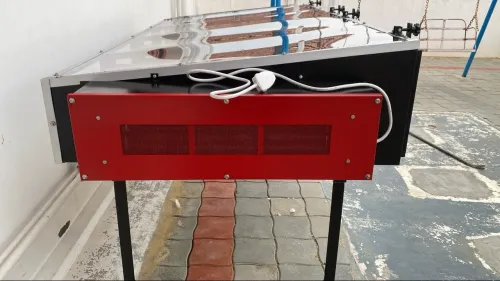
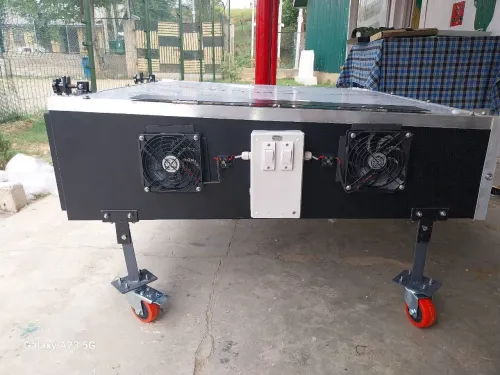
Depending on the Rudra Solar Dryer configuration selected, systems may use organised or forced airflow and an enclosed drying environment.
Actual drying performance still depends on the commodity, incoming moisture, loading, weather conditions and system design.
Enclosed Drying for Basti’s Agro-Processing Businesses
Completely open drying exposes agricultural material directly to outdoor surroundings.
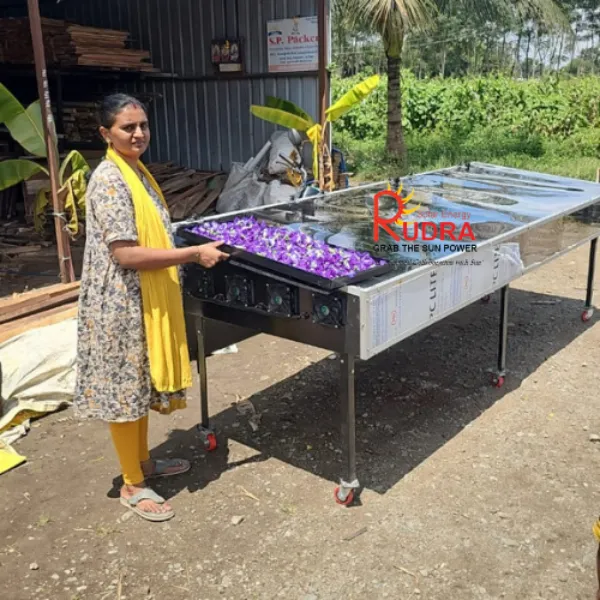
An enclosed solar dryer can provide a more organised processing environment and help reduce direct exposure of loaded material to dust, insects and other outdoor contaminants compared with fully open drying.
This can be useful for Basti businesses working toward a structured processing workflow such as:
Raw Produce → Sorting/Cleaning → Required Preparation → Moisture Assessment → Controlled Loading → Solar-Assisted Drying → Endpoint Assessment → Cooling → Packaging or Further Processing
The dryer performs the moisture-reduction stage.
It does not automatically wash, slice, mill, sterilise, package or guarantee the shelf life of the product.
Who Can Use a Solar Dryer in Basti?
A properly selected solar drying system may be relevant to:
Farmers
Farmer Producer Organisations (FPOs/FPCs)
Self-Help Groups
Agricultural cooperatives
Maize processors
Pulse-processing enterprises
Potato and vegetable processors
Food-processing MSMEs
Rural entrepreneurs
Post-harvest processing centres
Agricultural value-addition projects
The correct configuration can vary substantially between these users.
A farmer processing smaller seasonal quantities does not have the same requirement as an FPO aggregating produce from multiple villages or an enterprise operating several batches per day.
How Should a Basti Buyer Select Dryer Capacity?
Before selecting a solar dryer in Basti, a processor should ideally answer these questions:
1. What is the main commodity?
Maize, pulses and prepared potato require very different loading approaches.
2. What is the fresh or incoming quantity per day?
Peak-season volume is often more useful than an occasional maximum load.
3. In what form will the commodity enter the dryer?
Bulk grain and sliced vegetables use drying space differently.
4. What is the incoming moisture condition?
Drying requirement begins with the actual material condition.
5. How much usable drying area is required?
This becomes particularly important for sliced or prepared products.
6. How many batches are required per day?
7. During which season will the dryer operate most heavily?
8. Is solar-primary operation sufficient, or is optional backup required for the production schedule?
These inputs provide a more reliable basis for system sizing than choosing only by advertised capacity.
Solar Dryer Price in Basti – What Actually Changes the Cost?
There is no single universal solar dryer price in Basti because the required system depends on the processing operation.
Cost and configuration can vary according to:
- batch capacity
- drying area
- number and size of trays
- chamber dimensions
- airflow arrangement
- construction specification
- monitoring requirement
- solar-only or hybrid configuration
- optional backup requirement
- installation
- customisation
A potato processor requiring substantial tray area may therefore need a different configuration from a maize processor whose main concern is grain-bed depth and airflow.
Price comparison becomes more meaningful after the commodity and daily processing requirement are defined.
Solar-Primary or Hybrid Solar Dryer?
Basti processors whose schedules can accommodate variations in solar conditions may evaluate solar-primary operation.
Where production timing requires additional flexibility, an appropriate hybrid solar dryer or backup-assisted configuration can also be considered.
The decision should depend on:
commodity
daily batch quantity
processing season
required operating schedule
local weather conditions
acceptable drying window
The objective should be to configure the system around the processing requirement rather than automatically adding the same backup system to every installation.
Rudra Solar Energy for Basti Processing Requirements
Rudra Solar Energy develops solar dryer systems for agricultural and food-processing applications in different capacities and configurations.
For a Basti project, system selection can be evaluated according to:
Commodity + Incoming Quantity + Product Form + Moisture Requirement + Drying Area + Loading Depth + Airflow + Production Schedule
This makes it possible to distinguish between a maize-processing requirement, a pulse-processing requirement and a prepared-potato dehydration requirement instead of treating them as one generic application.
Businesses searching for a commercial solar dryer in Basti, solar dryer for agricultural products, solar grain dryer, maize drying machine, pulse dryer or solar food dehydrator can begin by sharing the main commodity and incoming batch quantity with Rudra Solar Energy.
That information provides a practical starting point for evaluating an appropriate solar dryer configuration.
Keywords