Bareilly has a large agricultural base combining major field crops with horticultural and diversified farming activities. Krishi Vigyan Kendra, Bareilly identifies wheat, paddy, sugarcane and pulses among the district’s major crops. Its frontline demonstration programmes also include carrot, leafy spinach, mentha and mango, showing the diversity of agricultural production and extension activity in the district.
For farmers, FPOs, SHGs, cooperatives and agro-processing enterprises, a solar dryer in Bareilly can be considered for suitable grain, vegetable, herb and other agricultural-product applications where controlled moisture reduction forms part of the post-harvest process.
The important point is that wheat, paddy, carrot and leafy vegetables cannot be treated as one common drying material. Their bulk density, initial moisture, physical form, loading method and airflow requirements differ considerably.
Solar dryer selection should therefore begin with the actual commodity and processing requirement.
Wheat Processing and Moisture Management in Bareilly
Wheat is one of the major crops documented in Bareilly’s district agricultural profile, and KVK Bareilly has also conducted frontline demonstrations involving improved wheat varieties.
For suitable wheat-processing requirements, a solar grain dryer can support moisture reduction before appropriate storage or further processing.
The first question should not be:
“How hot does the dryer get?”
A more useful assessment begins with:
Incoming grain moisture
Quantity per batch
Grain-bed depth
Available drying area
Airflow
Ambient conditions
Required moisture before storage or further processing
Wheat is a bulk particulate material. As loading depth increases, air must move through or across a deeper grain bed.
For this reason, simply filling the drying area with the maximum possible weight may not provide the most appropriate operating condition.
A commercial wheat-processing unit should evaluate both batch weight and airflow through the loaded grain.
Paddy Requires Its Own Drying Approach
Paddy is another major crop identified in Bareilly’s agricultural profile, and KVK demonstration programmes have included paddy cultivation and varietal improvement.
Where solar-assisted moisture management is appropriate, a solar dryer for paddy should be selected and operated according to the actual incoming grain condition and intended next stage.
Paddy drying can be influenced by:
Harvest moisture
Grain depth
Batch quantity
Air distribution
Operating temperature
Ambient humidity
Drying duration
Required moisture condition
Storage or milling requirement
The solar dryer performs the moisture-reduction stage.
Threshing, cleaning, dehusking, milling, grading and packaging remain separate agricultural or processing operations.
This distinction is important because a dryer should not be presented as a complete rice-processing machine.
Grain Drying Capacity Is More Than a Kilogram Number
Commercial buyers commonly compare drying systems using nominal capacity.
For grain applications, this is only part of the picture.
A processor should also ask:
How large is the usable drying area?
How deep will the grain layer be?
How does air reach the middle or lower portion of the loaded material?
How many batches need to be completed during peak season?
What moisture condition is required at unloading?
A system physically capable of holding a large quantity may not necessarily provide the best grain-drying arrangement if the product is loaded too deeply for the available airflow.
This is why a commercial solar dryer for grains should be matched to practical daily throughput rather than only maximum loading capacity.
Carrot Creates a Different Horticultural Application
KVK Bareilly’s horticultural demonstrations have specifically included carrot production and management.
Carrot introduces a very different processing requirement from wheat or paddy.
Where prepared carrot is intended for dehydration, the raw product usually needs appropriate cleaning and cutting before entering the drying stage.
Slice or piece thickness matters.
Thin and thick carrot pieces within the same batch may not lose moisture at the same rate.
A solar vegetable dryer for carrot should therefore be operated with attention to:
Fresh quantity
Preparation
Slice thickness
Tray distribution
Loading density
Airflow
Temperature
Ambient humidity
Required final moisture condition
The objective should be consistent preparation and organised tray loading rather than simply fitting the maximum quantity onto each tray.
Leafy Vegetables Need More Drying Area Relative to Weight
KVK Bareilly has also conducted demonstrations involving palak or spinach.
Leafy vegetables behave very differently from both grains and root vegetables.
Their relatively low bulk density means a small weight of fresh leaves can occupy substantial tray volume.
This makes usable tray area particularly important.
For suitable leafy-vegetable dehydration, processors should consider:
Leaf condition
Amount loaded per tray
Layer thickness
Air movement
Operating temperature
Ambient humidity
Required drying endpoint
Compressing leafy material into thick layers simply to increase kilograms per batch can restrict air movement.
A solar dryer for leafy vegetables should therefore be selected around drying surface and airflow as well as nominal capacity.
One Dryer, Different Products, Different Operating Decisions
Bareilly’s agricultural mix creates opportunities for multi-product processing businesses.
A suitably configured solar dryer may potentially support separate batches of compatible:
Wheat
Paddy
Pulses
Carrot
Leafy vegetables
Selected herbs
Fruits
Other suitable agricultural produce
However, the important rule is:
one dryer does not mean one setting.
Changing from wheat to carrot changes the product structure.
Changing from carrot to spinach changes the loading density.
Changing from leafy vegetables to grain changes how air moves through the material.
Each batch should therefore be assessed according to:
Commodity
Product form
Incoming moisture
Loading method
Airflow requirement
Temperature
Required final condition
Bareilly’s Pulses Add Seasonal Processing Flexibility
Pulses are also identified among Bareilly’s major crop groups, while KVK programmes have included crops such as arhar and lentil.
For suitable pulse-processing applications, moisture management should focus on the actual grain condition and downstream requirement.
Pulse batches can differ in:
Seed size
Bulk density
Initial moisture
Loading depth
Storage requirement
Airflow resistance
For an FPO working with several crops during different seasons, this means the same drying infrastructure may have useful seasonal flexibility if each commodity is operated separately and appropriately.
A solar dryer for agricultural products becomes more commercially useful when the operating process changes with the crop instead of treating all products identically.
What About Sugarcane?
Sugarcane occupies a major position in Bareilly’s agricultural profile.
However, being an important local crop does not automatically make a commodity a primary solar-drying application.
Sugarcane typically enters processing routes that differ substantially from the dehydration of prepared fruits, vegetables, herbs or grains.
For this reason, a Bareilly solar-dryer page should not force sugarcane into a drying application merely because it is widely cultivated.
Solar dryer selection should focus on materials for which moisture reduction is technically relevant to the intended product.
This commodity-specific approach is more useful for buyers than simply listing every crop grown in the district.
Airflow Connects Heat with Moisture Removal
A solar dryer does more than increase air temperature.
When wheat, vegetables or other produce releases moisture, that moisture enters the surrounding air.
The air then needs to move away from the product.
If warm but moisture-laden air remains around the material, further moisture reduction can slow.
This is why commercial buyers should evaluate:
Air inlet design
Airflow path
Tray spacing
Product loading
Grain-bed depth where applicable
Removal of humid air
Forced-air circulation where included
Solar heating and airflow should be considered together.
The relevant question is not simply:
“What is the maximum temperature?”
It is:
“How effectively can suitable drying air interact with the loaded product and remove released moisture?”
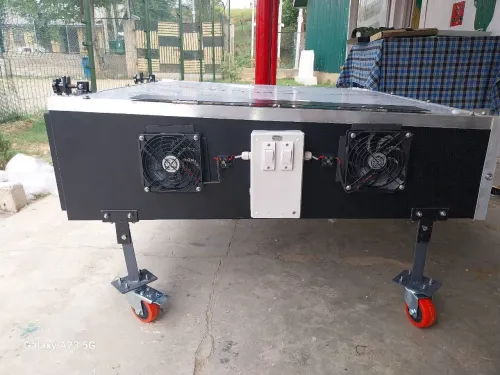
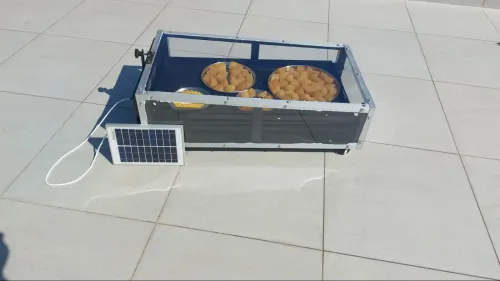
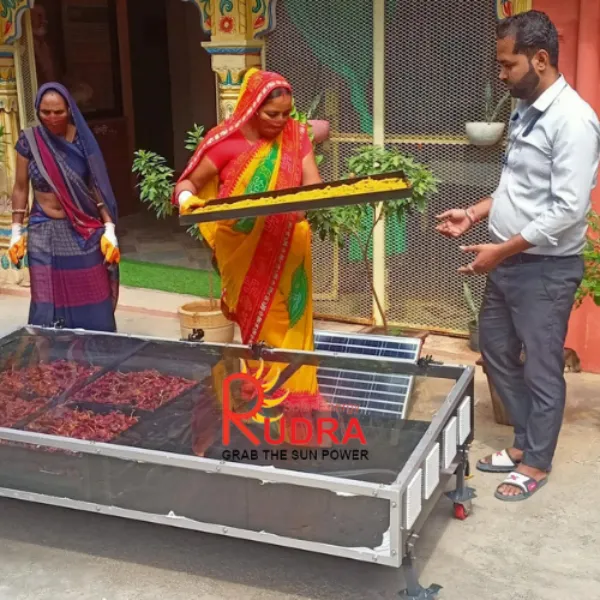
Cabinet Solar Dryer for Tray-Based Produce
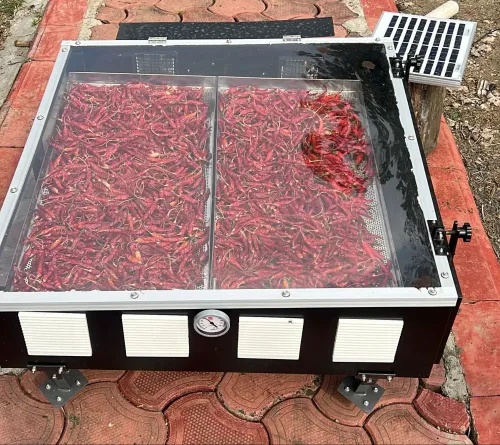
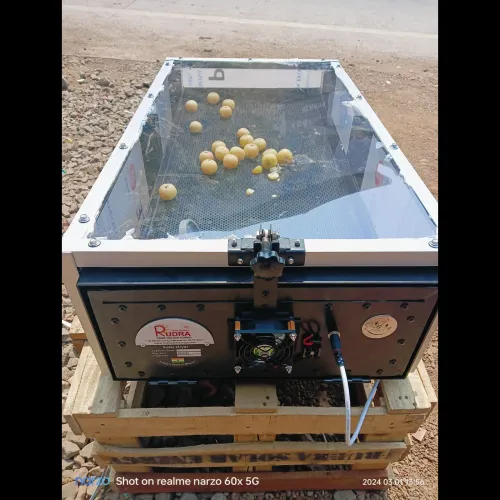
For vegetables, herbs and suitable smaller agricultural batches, a cabinet-style solar dryer can provide an organised tray-based processing arrangement.
This can be useful where the processor needs:
Separate trays
Defined batch loading
Controlled product distribution
Easy commodity changeover
Compact installation
Small or medium production quantities
Carrot slices, leafy vegetables and suitable fruit or herb batches can particularly benefit from considering available tray surface.
Rudra Solar Energy’s current product range includes commercial solar-dryer products and multiple solar-dryer applications for agricultural processing.
Larger Agricultural Batches Need Throughput Planning
An FPO or commercial processor may receive significantly more product than an individual farmer.
For larger requirements, equipment selection should begin with daily throughput.
The processor should calculate:
Fresh quantity received per day
Quantity requiring moisture reduction
Preparation capacity
Available loading area
Required number of batches
Peak-season incoming volume
Acceptable processing window
Available installation area
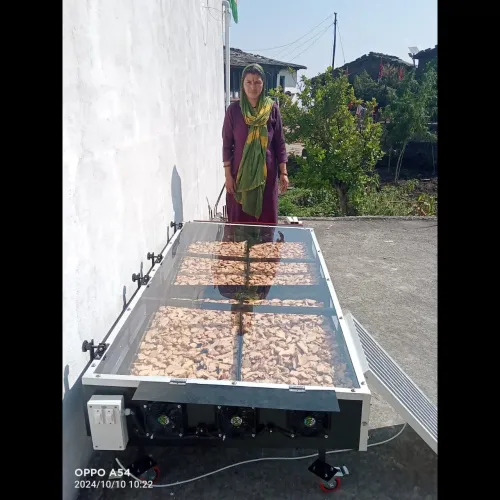
For larger drying requirements, an appropriate higher-capacity configuration may be more practical than repeatedly overloading a smaller system.
The correct design should follow the processing requirement.
Solar Food Dehydrator for Vegetable and Horticultural Processing
Buyers may search for similar equipment using terms such as:
Solar food dehydrator
Solar food dryer
Solar vegetable dryer
Solar dehydrator
Vegetable drying machine
Commercial solar dryer
These search terms often represent related equipment needs.
For Bareilly horticultural processors, the actual selection should still depend on the commodity.
A carrot-processing enterprise may prioritise uniform slicing and tray distribution.
A leafy-vegetable processor may require more usable drying surface relative to batch weight.
A multi-product FPO may prioritise operational flexibility.
The machine should therefore be selected around the processing workflow, not simply the terminology used during the search.
Solar-Primary or Hybrid Solar Dryer?
Available solar radiation and weather conditions affect solar-drying performance.
A processor whose production schedule is flexible may be able to work primarily during favourable solar conditions.
A commercial enterprise requiring additional operating flexibility may evaluate a hybrid solar dryer or suitable backup-assisted configuration.
The decision can depend on:
Crop or commodity
Processing season
Daily throughput
Operating schedule
Weather conditions
Required production continuity
Acceptable drying window
An optional backup system should be chosen based on real production needs rather than treated as necessary for every buyer.
Solar Dryer Price in Bareilly – Start with the Requirement
A single universal solar dryer price in Bareilly cannot accurately represent every application.
Cost can vary depending on:
Batch capacity
Drying area
Number of trays
Loading arrangement
Chamber size
Construction configuration
Airflow system
Solar-only or hybrid setup
Backup heating
Monitoring requirements
Installation
Customisation
A farmer handling small vegetable batches may need a very different system from an FPO processing grain or horticultural produce at commercial scale.
This is why price comparison should follow technical requirement definition.
Six Details to Share Before Requesting a Quote
A Bareilly buyer can provide:
1. Commodity
Wheat, paddy, carrot, leafy vegetables, pulses or another suitable product.
2. Quantity
Kilograms per batch or per day.
3. Product Form
Whole grain, leaves, slices, pieces or another prepared form.
4. Current Moisture / Processing Condition
How does the material reach the drying stage?
5. Production Schedule
Seasonal, periodic or regular commercial processing.
6. Backup Requirement
Is solar-primary operation suitable, or is additional operating flexibility required?
These details help determine the appropriate dryer type and capacity.
Solar Dryer for Bareilly Farmers, FPOs and Processing Enterprises
Potential users can include:
Farmers
Grain processors
Vegetable growers
FPOs and FPCs
Agricultural cooperatives
SHGs
Food-processing MSMEs
Rural entrepreneurs
Horticultural processors
Post-harvest centres
Institutional agriculture projects
Bareilly KVK operates within the ICAR-IVRI ecosystem at Izatnagar and maintains crop, horticulture, training and integrated-farming activities in the district.
For these users, the right dryer configuration should reflect normal production volume and commodity behaviour.
Rudra Solar Energy for Solar Dryer Requirements in Bareilly
Rudra Solar Energy provides solar dryer solutions for agricultural and food-processing requirements, with commercial solar-dryer products and application-oriented systems within its current product portfolio.
For Bareilly, equipment selection should start with the actual material being processed.
A wheat or paddy processor should consider grain-bed depth and airflow.
A carrot processor should focus on preparation consistency and tray loading.
A leafy-vegetable enterprise may prioritise larger usable drying surface relative to batch weight.
A multi-product FPO may need greater capacity flexibility across seasons.
For buyers searching for a solar dryer in Bareilly, solar dryer manufacturer in Bareilly, solar grain dryer, solar vegetable dryer, solar food dehydrator, commercial solar dryer or solar dryer for agricultural products, the best starting point is to share the commodity, normal quantity and processing requirement.
Rudra Solar Energy can then evaluate an appropriate solar dryer configuration according to the application.
Keywords