Baghpat is an agriculture-oriented district of western Uttar Pradesh where sugarcane is the principal crop, followed by wheat, mustard and vegetables, according to the district administration. The district horticulture department also actively supports cultivation of vegetables, spices, fruits and flowers, indicating a broader horticultural base beyond the major field crops.
For farmers, FPOs, SHGs and food-processing enterprises working with suitable vegetables, seeds, herbs and other agricultural produce, a solar dryer in Baghpat can provide an enclosed environment for organised moisture reduction using solar energy and managed airflow.
The application should, however, be selected according to the commodity. Sugarcane processing, vegetable dehydration and mustard-seed moisture management are very different operations and should not be treated as one universal drying process.
Why Solar Drying in Baghpat Should Focus on the Right Commodities
Baghpat's official crop profile includes sugarcane, wheat, paddy, potatoes, mustard and rapeseed, while its horticulture department promotes vegetables, spices, fruits and flowers.
This creates several potential moisture-management applications, but not every locally grown crop automatically belongs inside a solar dryer.
For example, making jaggery or sugar from sugarcane involves processing stages fundamentally different from dehydration, so a solar dryer should not be presented as a replacement for those operations.
More suitable drying applications can be evaluated for prepared:
- vegetables
- herbs and leafy materials
- selected spices
- seeds
- suitable fruits
- other agricultural products where moisture reduction is required
This commodity-first approach improves technical accuracy and helps buyers choose equipment according to the actual processing requirement.
Solar Drying of Vegetables in Baghpat
Vegetables are specifically identified among Baghpat's important agricultural produce, and the district horticulture department promotes vegetable cultivation.
Fresh vegetables generally contain substantial moisture. Where a processor intends to produce a dehydrated vegetable product, preparation may take place before drying according to the commodity.
Separate preparation stages may include:
Sorting → Cleaning → Cutting or Slicing → Tray Loading → Drying → Cooling → Moisture Checking → Packaging
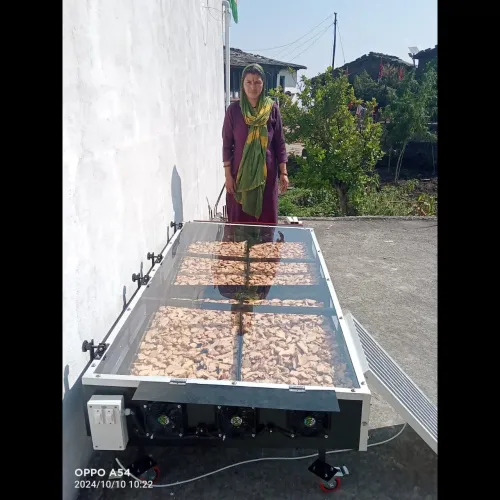
A solar dryer for vegetables then performs the moisture-removal stage.
Drying performance can vary according to:
- vegetable type
- initial moisture
- slice thickness
- size and shape
- tray loading density
- usable tray area
- airflow
- temperature
- relative humidity
- solar radiation
- required final moisture
For this reason, a processor should not assume that potato, leafy vegetables and sliced vegetables will all use the same operating conditions.
Tray Loading Can Matter More Than the Outer Size of the Dryer
One practical mistake in dehydration is evaluating a dryer only from its external dimensions or nominal kilogram capacity.
The actual drying process takes place across the available product surface and airflow path.
If vegetables are loaded in thick piles, heated air may not circulate effectively around individual pieces. The outside material may lose moisture faster while pieces inside the layer remain wetter.
A processor evaluating a solar food dryer in Baghpat should therefore ask about:
usable tray area,
recommended loading pattern,
tray spacing, and
air distribution through the chamber.
These details can be particularly important when processing sliced vegetables where exposed surface area strongly influences moisture removal.
Mustard and Seed Moisture Management
Mustard is one of the important crops identified by Baghpat district administration.
For suitable seed-processing applications, moisture management before storage can be important. However, the target moisture and drying method should depend on the seed, its initial condition and the intended use.
A solar drying system used for seed-related applications should therefore be operated differently from one used for high-moisture vegetables.
Seed material generally has:
- different bulk density
- different airflow resistance
- lower surface moisture behaviour
- different loading requirements
- a different desired drying endpoint
The objective should be controlled moisture reduction rather than exposing seeds to unnecessarily high temperatures.
For seed or agricultural-produce applications, operating conditions should therefore be selected according to the commodity rather than applying settings developed for fruits or vegetables.
Potato and Other Farm Produce: Preparation Comes First
Potato is also included among the crops listed on Baghpat district's official ODOP information page.
When potato is intended for dehydration, drying normally follows appropriate preparation.
A solar dryer does not wash, peel, slice, blanch, grind or package potatoes automatically.
These are separate processing stages where applicable.
Prepared potato pieces or slices may then be loaded into the drying system for moisture reduction. Uniform thickness can help reduce large differences in drying behaviour within the same batch.
This separation of operations is important because technically accurate content should explain what the solar dryer actually does instead of presenting it as a complete food-processing machine.
Why Airflow Is Essential for an Enclosed Solar Dryer
Heating alone does not complete the drying process.
As water moves from the agricultural product into the surrounding air, that air becomes more humid. Moisture-laden air needs to be removed so that additional moisture can continue leaving the product.
An enclosed drying system therefore needs appropriate air movement through the loaded chamber.
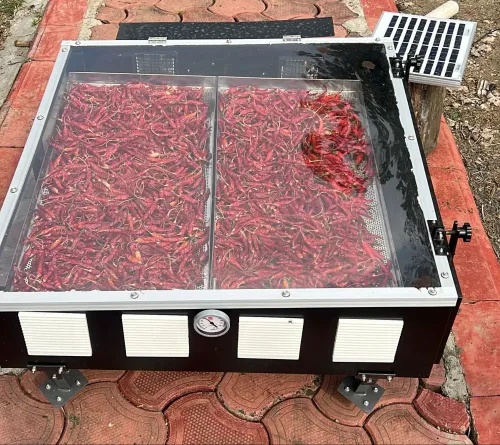
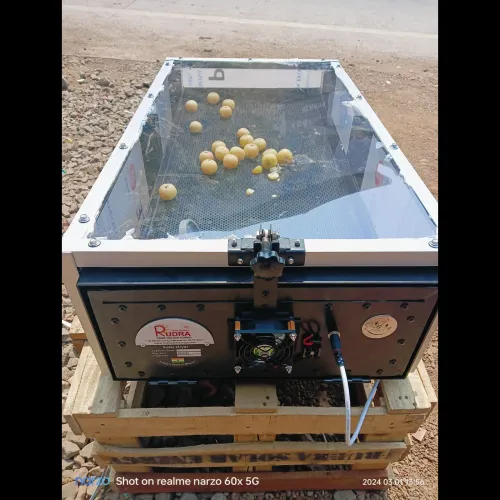
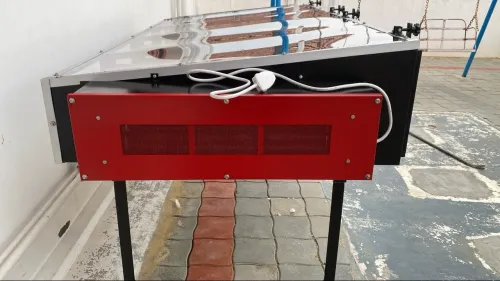
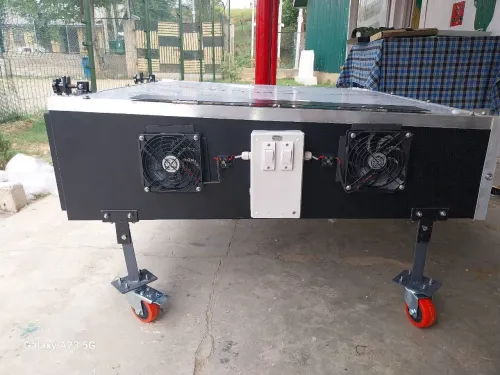
Depending on the relevant Rudra Solar Energy configuration, controlled or forced airflow and solar-powered DC fans may be used to support air movement.
However, more airflow is not automatically better for every product.
Lightweight herbs, dense seed layers and prepared vegetables can respond differently to air velocity and tray loading.
Airflow should therefore be considered together with:
commodity + moisture + loading + temperature + humidity + tray geometry.
Open Sun Drying vs Enclosed Solar Drying
Traditional open drying leaves produce directly exposed to the outdoor environment.
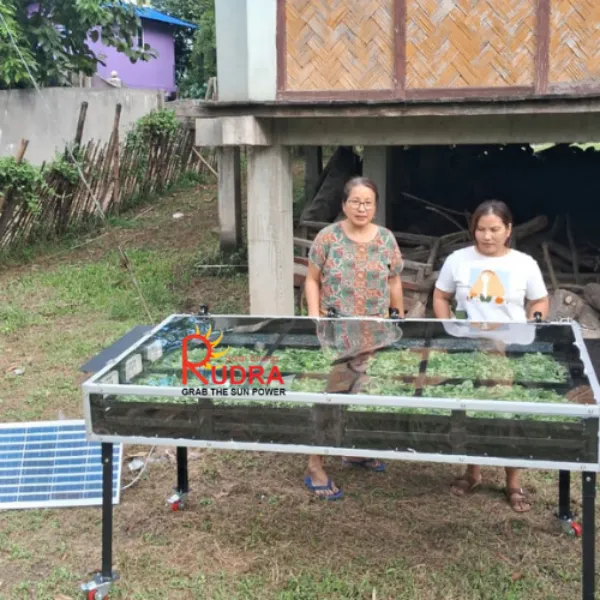
An enclosed solar dryer places the material inside a defined chamber where solar-heated air and organised airflow support moisture removal.
This can help reduce direct exposure to:
- dust
- insects
- animals
- unnecessary outdoor handling
compared with fully open drying.
However, using an enclosed solar dryer should not be interpreted as an automatic guarantee of food safety, shelf life or final product quality.
Those outcomes also depend on raw-material condition, sanitation, preparation, final moisture level, cooling, packaging and storage.
Can One Solar Dryer Handle Different Baghpat Products?
Potentially yes, depending on system design and the products involved.
A processor may need to handle vegetables during one season and selected herbs, seeds or other agricultural products during another.
A suitably configured solar dryer for agricultural products may provide this flexibility.
But multi-product use does not mean:
one temperature + one loading pattern + one drying time for everything.
Operating conditions should be reconsidered whenever the commodity changes.
Food-contact areas and trays should also be appropriately cleaned between product batches where required.
Solar-Only or Hybrid Solar Dryer for Baghpat?
Solar drying performance depends partly on available solar radiation and surrounding weather conditions.
On favourable sunny days, solar energy can support the required heat input. During cloudy or high-humidity periods, moisture removal may become slower.
An enclosed chamber protects the product from direct rainfall, but it should not be described as completely weather-independent.
Businesses that need tighter production scheduling can evaluate whether an optional hybrid solar dryer or backup-assisted configuration is appropriate for their process.
The decision should be based on:
- commodity
- processing season
- daily batch requirement
- operating hours
- acceptable drying window
- backup-energy availability
rather than selecting hybrid operation simply because it sounds more advanced.
What Should a Baghpat Buyer Provide Before Asking for a Quote?
For a meaningful solar dryer price or quotation, the supplier needs more information than only the district name.
A buyer should ideally provide:
1. Commodity
What exactly needs to be dried?
2. Fresh input quantity
How many kilograms are loaded per batch or per day?
3. Product form
Whole, sliced, chopped, leaves, seeds or another prepared form?
4. Operating season
When will most drying take place?
5. Current process
How is the product being dried today?
6. Backup requirement
Is solar-only operation acceptable, or is hybrid support required?
7. Processing objective
What final product is being prepared?
These details help determine the tray area, airflow arrangement and appropriate system capacity.
Solar Dryer for Farmers, FPOs and Food Processors in Baghpat
The district's agricultural base and active horticulture sector create potential applications for organised post-harvest processing. Baghpat's horticulture department specifically promotes fruit, vegetable and flower cultivation and supports modern horticultural practices.
Potential users of solar drying systems may include:
- farmers
- FPOs
- cooperatives
- SHGs
- vegetable processors
- seed-processing enterprises
- rural entrepreneurs
- food-processing MSMEs
The actual dryer configuration should be selected according to the user's normal production flow rather than choosing the largest available model.
Rudra Solar Energy for Solar Dryer Requirements in Baghpat
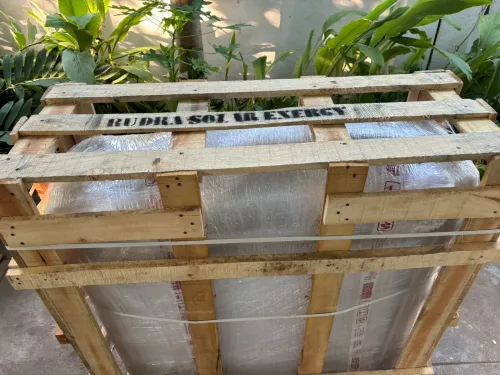
Rudra Solar Energy provides solar drying systems for agricultural and food-processing applications.
Depending on the relevant model or project configuration, systems may include features such as:
- enclosed drying chamber
- controlled or forced airflow
- food-contact trays
- solar-powered DC fans
- solar-only operation
- optional hybrid or backup arrangements
- multiple or customised capacities
Exact materials, construction and specifications can vary between models, so buyers should confirm the specifications of the system being considered.
For businesses searching for a solar dryer in Baghpat, the most useful starting point is to share the actual commodity, fresh input quantity, preparation method and operating requirement.
Processing vegetables, seeds or other suitable farm produce in Baghpat? Share your commodity and batch requirement with Rudra Solar Energy to evaluate an appropriate solar drying configuration.
Keywords