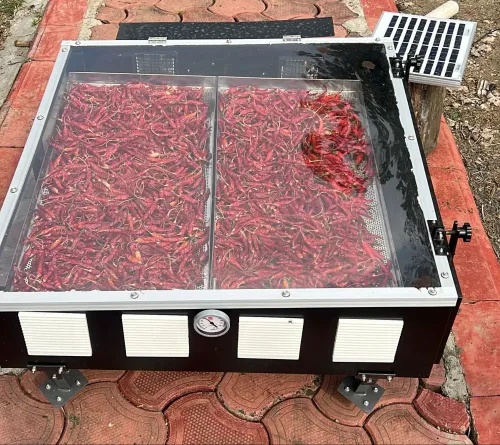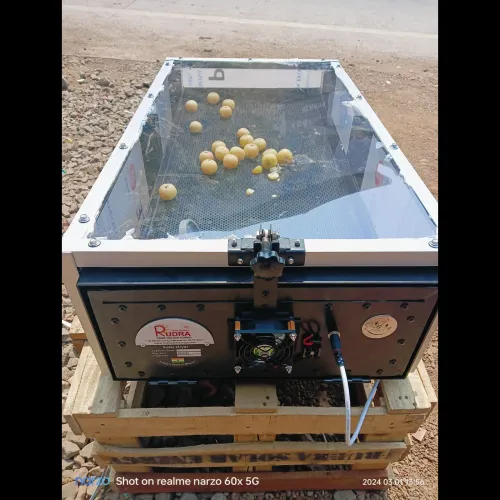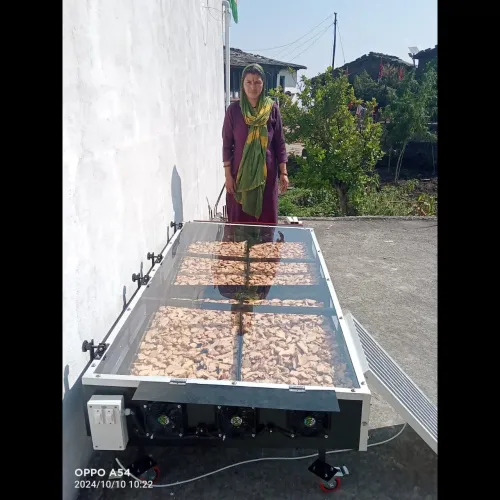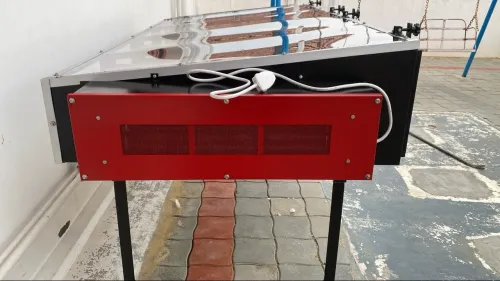
Azamgarh has a diversified agricultural base that includes paddy, wheat, arhar, maize, gram, pea, mustard and lentil, while the district’s horticultural profile includes onion, tomato, brinjal and ladies finger (okra). Krishi Vigyan Kendra, Azamgarh has also documented mushroom production activities, creating an additional value-addition opportunity for local growers and small processing enterprises.
For farmers, FPOs, SHGs and food-processing businesses handling suitable high-moisture produce, a solar dryer in Azamgarh can provide an enclosed environment for organised moisture reduction using solar heat and controlled air movement.
The important point is that mushrooms, onion and vegetables should not be treated as one identical drying application. Each product has different structure, moisture behaviour, preparation and loading requirements.
Mushroom Drying Requires Gentle and Controlled Handling
Mushroom gives Azamgarh a useful drying application that is different from conventional cereal or spice processing. The local KVK has included mushroom production units among its frontline demonstration activities.
Fresh mushrooms contain substantial moisture and have a delicate physical structure. When mushrooms are intended for dehydration, their preparation and tray arrangement need careful attention.
Depending on the intended dried product, the process may involve separate steps such as:
Selection → Cleaning → Cutting or Slicing → Tray Loading → Drying → Cooling → Moisture Assessment → Packaging
A solar mushroom dryer should support moisture removal without relying on excessively dense tray loading.
If mushrooms overlap heavily or are arranged in thick layers, heated air may not reach exposed surfaces uniformly. Appropriate spacing and airflow therefore become especially important.
Drying itself does not perform cleaning, slicing, grinding or packaging; those remain separate operations.
Why Airflow Matters for Mushroom Dehydration
A solar dryer does more than create heat.
As moisture leaves mushrooms during drying, the surrounding air becomes increasingly humid. That moisture-laden air needs to move away from the product so that further moisture removal can continue.
For this reason, mushroom drying should consider:
- fresh product moisture
- mushroom size
- slice thickness where applicable
- tray loading density
- usable tray area
- airflow velocity and distribution
- drying temperature
- ambient humidity
- target moisture condition
There is no universal drying time that should be promised for every mushroom batch.
Actual performance changes with product condition, weather, loading and system configuration.
Solar Drying of Onion in Azamgarh
Onion is among the vegetable crops listed in the Azamgarh KVK district profile.
For dehydration applications, onion requires a process different from mushroom drying. Preparation may involve peeling and cutting or slicing before the material enters the dryer.
Uniform preparation matters because thicker pieces generally retain more internal moisture than thinner pieces.
When prepared onion is loaded inside an enclosed solar food dryer, air should be able to move across the product rather than being blocked by heavily packed trays.
For processors evaluating onion dehydration, useful questions include:
How much fresh onion will be processed per batch?
What form will be dried — slices, rings or another prepared form?
How much usable tray area is available?
How will moist exhaust air leave the chamber?
These technical questions are more useful than selecting a dryer only on the basis of its external dimensions.
Brinjal and Okra Offer Additional Vegetable Drying Applications
Azamgarh’s KVK profile also lists brinjal and ladies finger (okra) among local vegetables.
These products have different shape, surface characteristics and internal moisture from onion or mushroom.
Where they are suitable for dehydration, preparation should be standardised before tray loading. Uneven pieces can create differences in drying behaviour within the same batch.
A solar dryer for vegetables can support moisture reduction from prepared produce while keeping the material inside an enclosed drying environment.
However, the same operating procedure should not automatically be used for:
mushroom, onion, brinjal and okra.
The processor may need to adjust preparation, loading depth, airflow and endpoint assessment according to each commodity.
Can One Solar Dryer Handle Multiple Azamgarh Crops?
For a farmer group or processing enterprise handling seasonal produce, a suitable multi-purpose solar dryer may be used for different compatible commodities at different times.
For example, separate batches might include:
- mushroom
- onion
- brinjal
- okra
- tomato
- selected fruits
- herbs
- pulses or other technically suitable agricultural products
But multi-product capability does not mean one universal drying setting.
Before switching between products, the processor should consider appropriate cleaning of food-contact surfaces and adjust loading and operating conditions for the new commodity.
This makes usable tray area, airflow design and operational flexibility important when selecting a solar dryer for agricultural products.
Solar-Only or Hybrid Solar Dryer?
Solar drying depends on available solar radiation and ambient conditions.
During favourable sunny conditions, solar energy can provide the heat needed to support moisture removal. During cloudy or humid periods, drying may become slower because less useful solar heat is available and incoming air may already contain more moisture.
An enclosed chamber can help protect the product from direct rain and outdoor exposure, but it should not be described as completely independent of weather.
Azamgarh businesses that need greater operational flexibility can therefore evaluate whether a hybrid solar dryer or backup-assisted configuration is appropriate for their processing schedule.
The need for backup should be decided according to:
- operating season
- daily production requirement
- product sensitivity
- available drying window
- desired process continuity
Solar Dryer Selection for FPOs and Food-Processing Businesses
A commercial buyer should begin with the processing requirement rather than simply asking for the “largest” solar dryer.
Important inputs include:
Commodity mix: Mushroom only, vegetables only or multiple products?
Fresh input quantity: Kilograms loaded per batch or per day.
Preparation: Whole, sliced or otherwise prepared material.
Tray requirement: Usable surface area needed for the normal batch.
Airflow: Appropriate movement of heated air through the loaded chamber.
Season: Months when the unit will normally operate.
Backup: Whether solar-only or hybrid operation is required.
These details help determine a more appropriate drying configuration and also make solar dryer price or cost discussions more meaningful.
Why Enclosed Solar Drying Is Different from Open Drying
Open-air drying exposes the product directly to its surroundings.
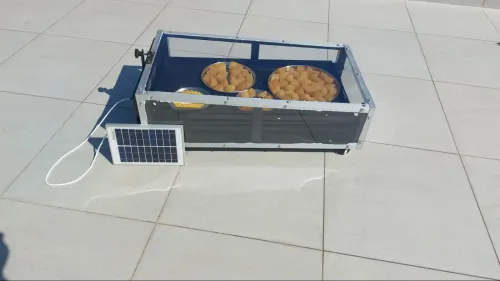
An enclosed solar dryer creates a defined drying chamber where prepared material can be arranged on trays while solar-heated air supports moisture removal.
This can help reduce direct exposure to dust, insects and other external contamination compared with fully open drying.
However, final product quality still depends on several factors beyond the dryer itself, including:
raw-material condition, preparation, hygiene, moisture endpoint, cooling, packaging and storage.
A solar dryer should therefore be treated as one controlled stage within the broader processing workflow.
Rudra Solar Energy for Solar Dryer Requirements in Azamgarh
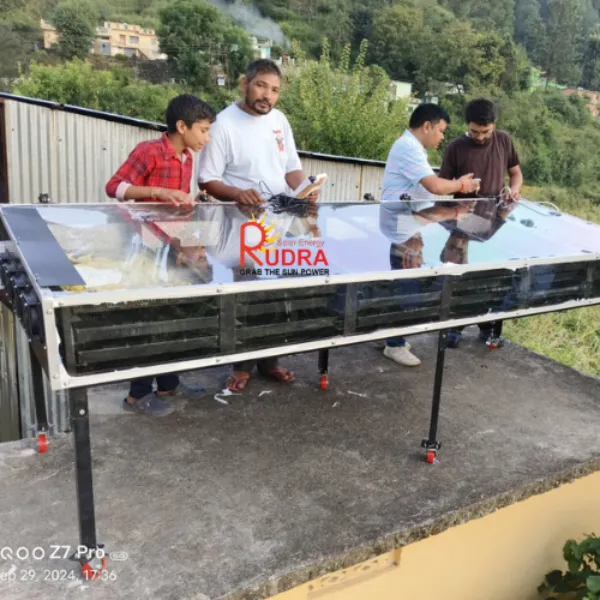
Rudra Solar Energy provides solar drying systems for agricultural, horticultural and food-processing applications.
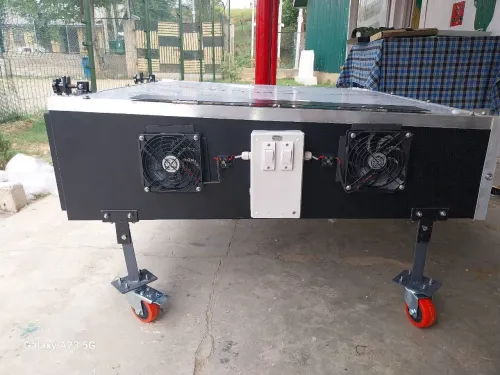
Depending on the relevant configuration, systems may use an enclosed chamber, controlled or forced airflow, food-contact trays, solar-powered DC fans and optional hybrid or backup arrangements.
Exact material specifications and features can vary by model, so system selection should be based on the actual application rather than assuming every solar dryer has identical construction.
For an enterprise searching for a solar dryer in Azamgarh, the most useful starting information is:
what product needs to be dried, how many kilograms are processed fresh, how the product will be prepared, and during which season the dryer will operate.
For mushroom, onion and vegetable processing in particular, matching tray area + loading pattern + airflow + operating conditions to the commodity is more technically useful than relying on one standard drying formula.
Planning mushroom, onion or vegetable dehydration in Azamgarh? Share your commodity and fresh batch quantity with Rudra Solar Energy to discuss an appropriate solar drying configuration.
Keywords