
Description
Solar Spices Dryer in India – Solar Dryer for Chilli, Turmeric, Ginger & Spice Processing
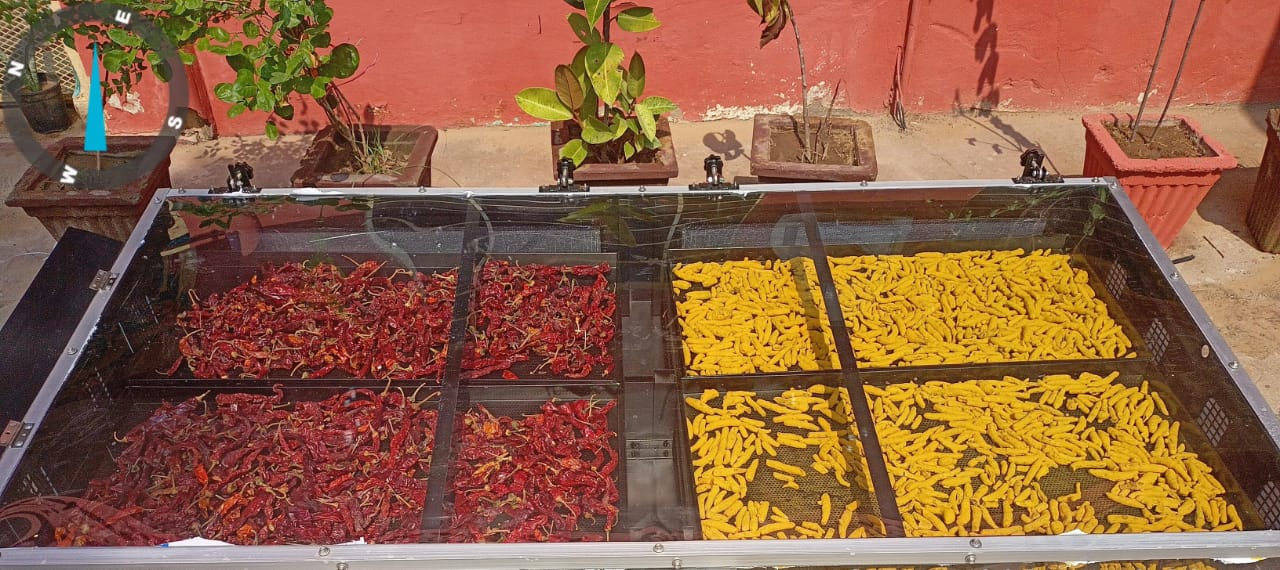
Rudra Solar Energy’s Solar Spices Dryer is an enclosed solar drying system designed for controlled moisture reduction from suitable spices such as red chilli, turmeric, ginger, coriander, cumin, black pepper, cardamom, cloves, cinnamon, fennel and other spice materials. The system combines solar thermal heating, organised tray loading and controlled air movement to provide a more protected drying environment than direct open-sun exposure. It is suitable for spice farmers, FPOs, SHGs, cooperatives, food-processing MSMEs and commercial spice processors, while the correct dryer configuration should be selected according to the spice, preparation method, incoming moisture, batch quantity, usable tray area, airflow, weather conditions and required final moisture.
What is a Solar Spices Dryer?
A Solar Spices Dryer is an enclosed drying system that uses solar thermal energy to remove moisture from suitable prepared spices.
Instead of spreading spices directly in open surroundings, the material is arranged inside a drying chamber where solar heat and air circulation support controlled moisture removal.
The dryer performs the drying stage only. Cleaning, washing, peeling, slicing, boiling, curing, grinding, milling, powdering, blending and packaging remain separate operations wherever they are required for the particular spice.
How does a Rudra Solar Spices Dryer work?
Solar radiation enters the drying system and contributes heat inside the enclosed chamber. Prepared spice material absorbs this heat, moisture begins moving from the product into the surrounding air, and air circulation helps carry moisture-bearing air out of the dryer.
Rudra’s technical FAQ describes the system as using the combined effect of radiation, conduction and convection, with hot-air circulation supporting moisture removal.
For spice drying, this means temperature alone is not enough. Heat, airflow, tray loading and product preparation must work together.
Which spices can be dried in a Rudra Solar Spices Dryer?
Depending on the exact crop and required final product, suitable applications can include:
Red Chilli
Turmeric
Ginger
Coriander
Cumin / Jeera
Black Pepper
Cardamom
Cloves
Cinnamon
Fennel
Fenugreek
Ajwain
Garlic for suitable spice-processing applications
Other compatible spices and seasoning materials
These spices should not all be treated as one identical drying load. Fresh ginger, cured turmeric, chilli, cumin seed and cardamom differ greatly in moisture, structure, bulk density and processing requirements.
Can red chilli be dried in a Solar Spice Dryer?
Yes. Red chilli is one of the important commercial applications for solar spice drying.
A suitable drying process should consider chilli variety, maturity, initial moisture, whole or prepared form, tray loading, airflow, temperature, humidity and required final moisture.
Raheja currently gives chilli significant visibility across its national and state solar-dryer pages, including Gujarat, Andhra Pradesh and Karnataka. That is why this dedicated Rudra page should go beyond simply saying “chilli can be dried” and directly answer how chilli-dryer selection works.
Can turmeric be dried using a Solar Spices Dryer?
Yes, suitably prepared turmeric can be dried using an appropriate solar drying configuration.
However, turmeric processing and turmeric drying are not the same thing. Depending on the chosen processing method, operations may include cleaning, curing or boiling, draining, drying, polishing, grinding and packaging.
The Solar Spices Dryer performs the moisture-reduction stage. It should not be described as automatically converting fresh turmeric into finished turmeric powder.
Can ginger be dried in a solar dryer?
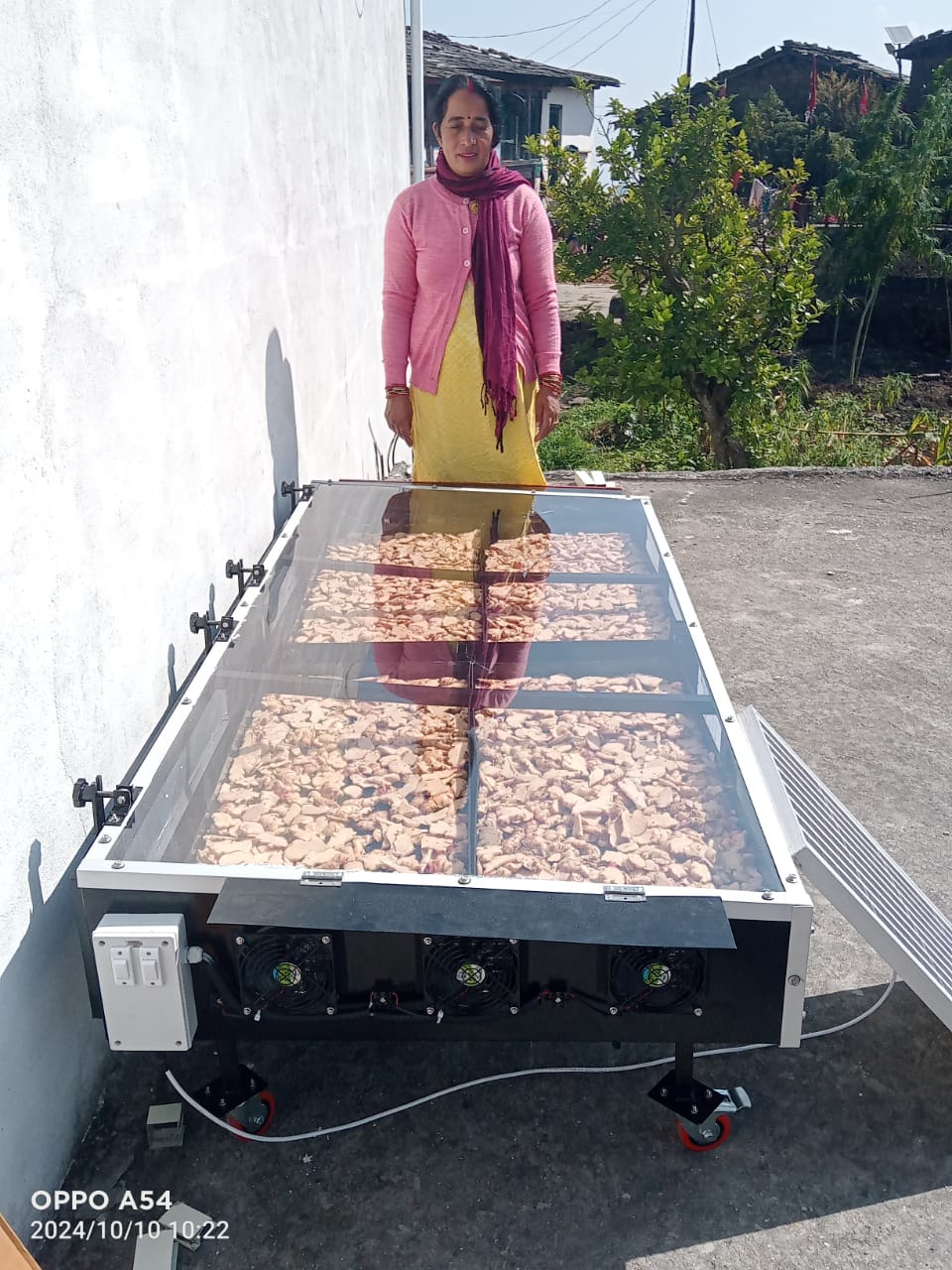
Yes. Properly prepared ginger can be solar dried where dehydration is part of the intended processing workflow.
Product form is especially important for ginger. Rudra’s own technical FAQ uses ginger as an example showing that whole material and thinner slices can have very different tray loading and drying behaviour.
For ginger processing, dryer selection should therefore consider prepared form + tray area + moisture load, not fresh weight alone.
Can coriander and cumin seeds be dried using solar energy?
Yes. Coriander and cumin are suitable spice-drying applications when moisture reduction is required before storage, trading or further processing.
Because these are relatively small seed-type materials, tray loading and airflow should be selected differently from high-moisture materials such as fresh ginger.
The process should consider initial moisture, seed-layer depth, airflow, operating conditions and target final moisture.
Can black pepper and cardamom be dried in the same Solar Spice Dryer?
A suitably configured dryer may potentially process compatible spices in separate batches, but black pepper and cardamom should not automatically use identical drying conditions.
They can differ in:
Product Structure
Incoming Moisture
Temperature Sensitivity
Layer Depth
Airflow Requirement
Desired Appearance
Final Moisture
Multi-spice capability therefore means the equipment may support different applications—not that every spice uses one universal setting.
How does spice preparation affect drying?
Preparation can significantly affect moisture removal.
Depending on the spice, separate preparation may include sorting, cleaning, washing, cutting, slicing, peeling, draining, curing or other commodity-specific steps.
Rudra’s FAQ specifically identifies particle size, initial moisture, weather, sunlight and local humidity as factors affecting drying duration.
This is particularly relevant for turmeric and ginger, where whole and prepared material can behave very differently.
How long does spice drying take in a Solar Spice Dryer?
There is no single fixed drying time for all spices.
Drying duration depends on the spice, incoming moisture, required final moisture, product size, preparation, tray loading, layer depth, airflow, operating temperature, relative humidity, solar radiation and dryer configuration.
Therefore, the old blanket claim that every spice dries 40–60% faster should not be treated as a guaranteed performance figure.
Actual drying performance should be evaluated for the specific spice and operating conditions.
What temperature is suitable for drying spices?
Rudra’s supplied FAQ states that under suitable clear-sun conditions its solar dryer systems may achieve temperatures up to approximately 80°C, depending on ambient conditions and fan operation.
But:
Maximum dryer temperature ≠ correct temperature for every spice.
Chilli, turmeric, cardamom, coriander and ginger can have different product-quality and processing requirements.
The operating temperature should therefore be selected according to the specific spice, its moisture condition and required final product.
Can the temperature be managed in a Rudra Solar Spices Dryer?
In applicable Rudra models, fan operation contributes to both airflow and temperature management.
The supplied technical FAQ notes that fan switching or regulation can be used in relevant models to manage seasonal variation in dryer conditions.
For commercial processing requiring additional continuity, a suitable hybrid configuration can also be considered.
Why is airflow important for spice drying?
As spice material heats, moisture leaves its surface and enters the drying air.
That moisture-bearing air must then be moved away so the drying process can continue efficiently.
Airflow therefore interacts with:
Product Depth
Particle Size
Tray Spacing
Initial Moisture
Temperature
Ambient Humidity
Rudra’s FAQ specifically states that the fans help remove moisture released by material inside the drying chamber.
Overloading trays can restrict useful airflow even when chamber temperature is high.
How are the fans powered in a Rudra Solar Spice Dryer?
In relevant Rudra configurations, DC fans are powered through a solar photovoltaic panel.
The panel supplies electricity for fan operation.
The principal drying heat comes from solar radiation converted into thermal energy, rather than the PV panel directly heating the spice material.
This makes the system primarily a solar thermal drying technology with solar-powered air circulation.
Which trays are used in Rudra Solar Spices Dryers?
Rudra’s technical FAQ states that specially developed food-contact metal trays are used, with perforated or plain configurations selected according to the material being processed.
The standard scope identifies food-grade aluminium trays, while SS304 trays can be provided on special request at additional cost.
For fine spices or seed-type material, tray design should be selected with attention to particle size and airflow.
What is the standard Rudra Solar Dryer tray size?
The standard interchangeable tray specified in Rudra’s FAQ measures approximately:
16 × 32 × 1 inches
with an area of approximately:
512 sq. inches / 3.55 sq. ft. / 0.33 sq. metre per tray.
Usable tray area matters because two spices weighing the same can occupy very different physical drying space.
Does a 50 kg Solar Spice Dryer mean 50 kg of every spice?
No.
Nominal capacity should not be interpreted as identical usable loading for chilli, turmeric, ginger, coriander, cumin, pepper and every other spice.
Practical loading depends on:
Spice + Product Form + Bulk Density + Moisture Load + Tray Area + Layer Depth + Airflow
For this reason, dryer capacity should be selected around the actual commodity rather than only a kilogram label.
What capacity Solar Spices Dryers does Rudra offer?
Rudra offers multiple tray and commercial dryer configurations for different processing volumes.
The current live Solar Spices Dryer specification lists a 5 kg to 500 kg average loading range, while the older description separately mentions 50 kg, 100 kg, 200 kg and 500 kg+ models.
Aa ek factual discrepancy che je publish karta pehla internally confirm karvi joiye.
Until confirmed, buyer-facing copy should simply state that multiple capacities are available and that actual usable loading depends on the spice.
Is a Rudra Solar Spices Dryer protected from dust and insects?
Rudra Solar Dryers use an enclosed drying environment with filters designed to reduce entry of dust and insects.
The company FAQ specifies industrial dust filters as well as inlet and outlet insect filters.
This provides a more protected processing environment than spreading spices directly in open surroundings.
Does the dryer protect spices from birds and animals?
Yes. The material remains within an enclosed drying chamber, reducing direct access by birds and animals during normal operation.
This benefit is also specifically stated in Rudra’s technical FAQ.
Does solar drying preserve the colour, aroma and flavour of spices?
Controlled drying can be managed with the objective of maintaining desirable spice quality, but zero change should not be guaranteed.
Colour, aroma, flavour and volatile components can be influenced by:
Raw Material Quality
Maturity
Preparation
Temperature
Airflow
Drying Duration
Oxidation
Final Moisture
Storage Conditions
Rudra’s original FAQ makes a strong retention claim but also acknowledges that oxidation may occur when some products are exposed to air.
This more precise wording is stronger from an EEAT perspective than promising perfect retention in every batch.
Can a Solar Spice Dryer make chilli powder or turmeric powder?
No. Drying and powdering are separate processes.
The Solar Spices Dryer removes moisture from suitable spice material.
Producing spice powder normally requires additional downstream stages such as:
Cooling
Grinding
Milling
Sieving
Blending
Packaging
The dryer should therefore not be advertised as a complete masala or spice-powder manufacturing machine.
Can the Solar Spices Dryer be used by spice exporters?
It can form part of a suitable processing workflow for businesses serving domestic or export markets.
However, use of a solar dryer does not automatically guarantee export quality or regulatory compliance.
Finished-product suitability can also depend on moisture, contaminants, residues, microbiological requirements, packaging, traceability and buyer specifications.
This distinction helps the page target solar dryer for spice industry and exporter intent without making unsupported compliance claims.
Is a Hybrid Solar Spice Dryer available?
Yes. Depending on the selected Rudra model, a Solar + Electric Hybrid or other applicable backup configuration can be considered.
Hybrid operation may be useful where processors need additional flexibility during:
Cloudy Weather
High Humidity
Peak Spice Season
Defined Production Schedules
Reduced Solar Availability
Rudra’s technical FAQ confirms that hybrid models can use grid-powered backup when solar heating is unavailable.
Can a Solar Spices Dryer work at night?
A normal solar-only dryer does not receive solar thermal energy at night.
Where processing needs to continue without sunlight, an applicable hybrid dryer with a backup energy source should be selected.
This should be clearly distinguished from solar-only operation rather than describing every dryer as “all weather.”
Does solar spice drying have zero operating cost?
No fixed zero-cost claim should be made.
Solar energy can reduce dependence on purchased fuel or electricity for primary heating during favourable conditions, but total processing costs can still include labour, cleaning, preparation, maintenance, packaging, storage and hybrid energy where used.
This wording targets commercial buyer concerns without making an unrealistic claim.
Does a Solar Spice Dryer guarantee higher profit?
No equipment can guarantee farmer or processor profit.
A solar dryer can support value-addition by enabling a controlled moisture-reduction stage, but actual profitability depends on product yield, market price, buyer demand, quality, processing cost, labour, packaging and the sales channel.
The commercial benefit should therefore be positioned as an opportunity, not a guaranteed income result.
Is installation required for a Rudra Solar Spices Dryer?
Many cabinet-type Rudra dryers are supplied as ready-to-use or minimal-assembly systems.
Rudra’s FAQ states that applicable models may only require unpacking, basic support fitting where needed, removal of protective covering, connection of the solar panel and switching on the fans.
Exact installation requirements depend on the selected dryer capacity and configuration.
What maintenance does a Solar Spice Dryer require?
Routine maintenance can include keeping trays and the chamber clean, checking dust and insect filters, inspecting fans, keeping the solar panel clean, checking electrical/control components and inspecting the polycarbonate covering.
Rudra’s technical FAQ identifies fans, electrical components and polycarbonate covering as serviceable items that may require attention or replacement over time.
Spice residues should also be cleaned appropriately when switching between commodities.
What after-sales support does Rudra Solar Energy provide?
Rudra Solar Energy states that customer troubleshooting can be supported through telephone, video call and other online communication channels.
Its supplied FAQ also describes remote assistance for component replacement and troubleshooting where necessary.
Exact warranty and service conditions should be confirmed for the purchased model.
From where is the Rudra Solar Spices Dryer tested?
Rudra Solar Energy states that its solar dryer technology has been tested and validated through multiple IITs, agricultural institutes, KVKs, JSS and ICAR test laboratories, along with field operation across Indian states and Union Territories.
For this product page, the claim should remain tied to the broader Rudra Solar Dryer technology unless a specific Spice Dryer test certificate names the exact model.
Is the Solar Spices Dryer suitable for farmers, FPOs and commercial processors?
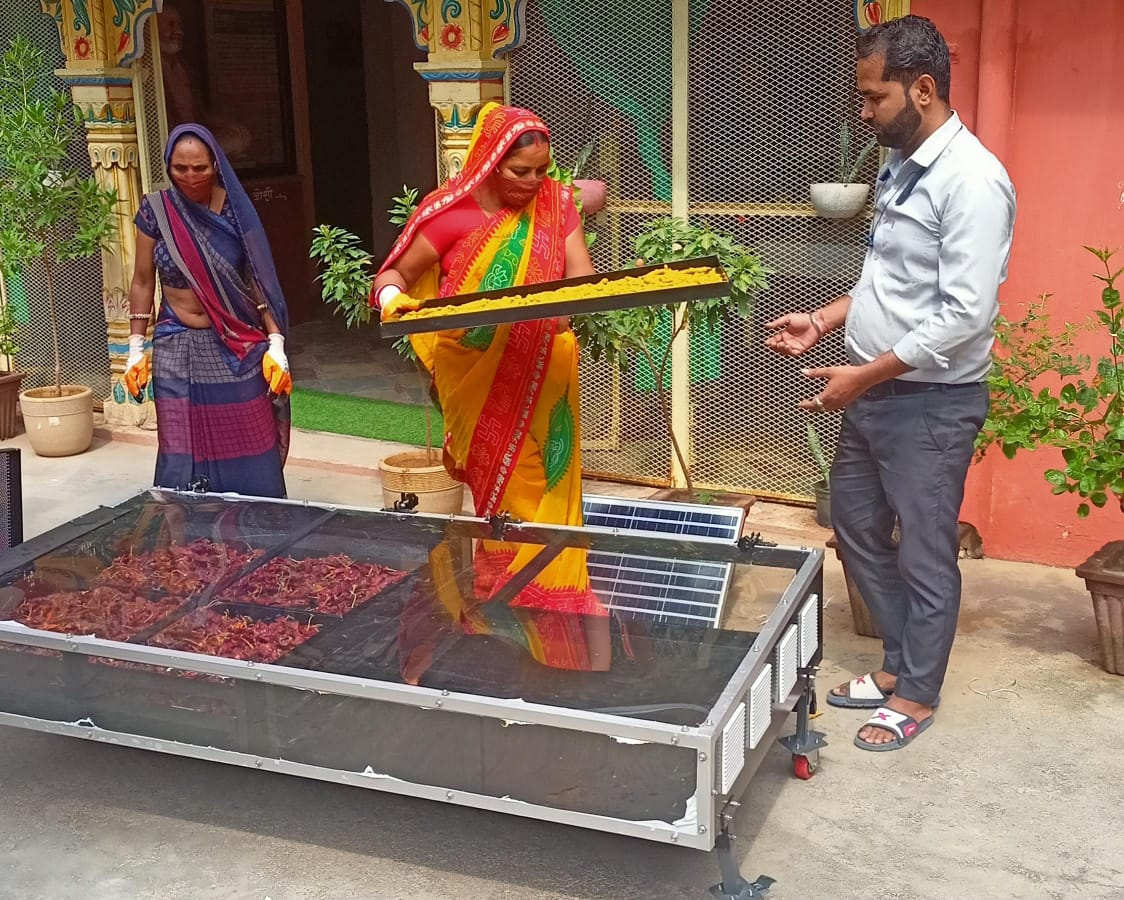
Yes. Depending on capacity and configuration, potential users include spice growers, farmers, FPOs, FPCs, SHGs, cooperatives, women-led processing groups, food-processing MSMEs, spice manufacturers and larger commercial processors.
The right dryer should be selected from the processor’s actual daily spice quantity and seasonal throughput, not simply the largest available capacity.
What is the price of a Solar Spice Dryer in India?
Solar Spice Dryer price depends on the model and technical configuration.
Important price factors include capacity, number of trays, usable drying area, construction, tray material, airflow system, solar fan configuration, controls, solar-only or hybrid design, backup heating and customisation.
The current Rudra product page itself targets terms such as solar dryer price for spices, while other commercial results also expose direct Spice Dryer pricing, so price intent is important enough to answer directly on this page.
For an accurate quotation, the buyer should share the spice and daily processing quantity.
How should I choose a Solar Spice Dryer manufacturer in India?
A buyer should compare more than machine price.
Before selecting a Solar Spice Dryer manufacturer in India, ask whether the supplier can explain:
The practical loading for your spice
Usable tray area
Tray material
Airflow mechanism
Temperature capability
Fan and solar-panel arrangement
Solar-only versus hybrid options
Dust and insect protection
Installation requirements
Maintenance
After-sales service
Testing and validation
A technically responsible manufacturer should first understand the spice and processing requirement before recommending a capacity.
What details should I share before buying a Rudra Solar Spices Dryer?
For a better recommendation, share the exact spice, material form, fresh or incoming quantity per batch/day, current moisture if known, preparation method, required final product, peak processing volume, installation location and whether solar-only or hybrid operation is required.
For example, a processor handling sliced ginger requires a different sizing discussion from one mainly processing cumin or coriander seed.
Why choose Rudra Solar Energy for spice drying?
Rudra Solar Energy develops solar drying systems for agricultural, food-processing and commercial applications across multiple tray and capacity configurations.
The Rudra Solar Spices Dryer is selected around the actual spice, incoming material form, moisture load, usable tray area, airflow and required processing schedule rather than treating chilli, turmeric, ginger, coriander, cumin and cardamom as identical drying loads.
For buyers searching for a Solar Spices Dryer in India, Solar Spice Dryer, Solar Dryer for Spices, Spice Drying Machine, Solar Spice Drying Machine, Solar Dryer for Chilli, Solar Dryer for Turmeric, Solar Dryer for Ginger, Hybrid Solar Spice Dryer or Solar Spice Dryer Manufacturer in India, Rudra Solar Energy can evaluate the system according to the actual processing requirement.
Specifications
| CAPACITY RANGE | 5 KG TO 500 KG AVERAGE LOADING |
|---|---|
| LIFE | 10 YRS |
| GRADE | FOOD GRADE |
| EFFICIENCY | 65% |
| TOP COVER | DOUBLE UV PC SHEET |
| BODY MATERIAL | HIGH QUALITY RUST PROOF ALUMINIUM |