
Enabling Better Livelihoods Through Solar Drying
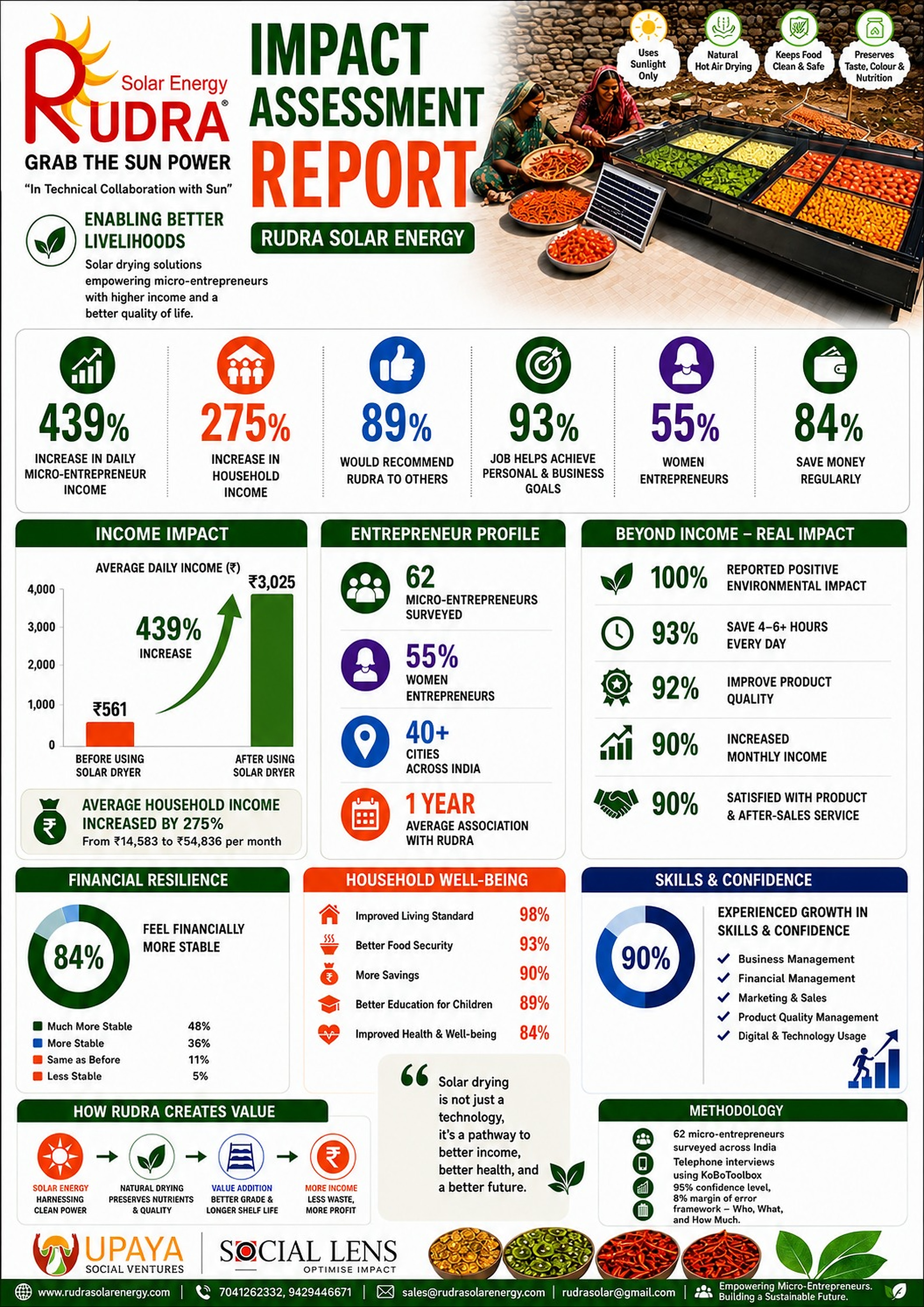
Rudra Solar Energy’s Impact Assessment Report examines how solar drying solutions are contributing to income generation, rural enterprise development, women’s participation, time savings, product quality and household well-being.
The assessment covers 62 micro-entrepreneurs located across more than 40 cities in India. Participants had been associated with Rudra Solar Energy for an average of approximately one year at the time of the survey.
The findings provide experience-based insights into how Rudra Solar Dryers are being used by micro-entrepreneurs to process agricultural and food products, reduce dependence on open sun drying, support value addition and create livelihood opportunities.
Independent Third-Party Impact Assessment
The assessment was carried out by Social Lens, an external third-party impact measurement and evaluation organisation, in collaboration with Upaya Social Ventures. Rudra Solar Energy was the organisation being assessed; the micro-entrepreneur survey was not conducted as an internal self-assessment by Rudra Solar Energy.
The findings are based on structured telephone interviews conducted with 62 micro-entrepreneurs across India using KoboToolbox. The reported methodology states a 95% confidence level and an 8% margin of error. The outcomes presented in the report reflect the responses and experiences shared by the surveyed participants.
What Does the Rudra Solar Energy Impact Assessment Measure?
The assessment examines reported changes across five interconnected areas:
- Micro-entrepreneur and household income
- Women’s participation in entrepreneurship
- Time savings and product-quality outcomes
- Financial resilience and household well-being
- Business skills, confidence and environmental awareness
The assessment goes beyond product usage and explores how access to solar drying technology may support enterprise development and quality of life.
Who Participated in the Impact Assessment?
The participant profile included:
- 62 micro-entrepreneurs surveyed
- Participants from more than 40 cities across India
- 55% women entrepreneurs
- Approximately one year of average association with Rudra Solar Energy
The survey therefore reflects the experiences of users operating in different markets, livelihood settings and food-processing contexts.
How Was the Impact Assessment Conducted?
The assessment was conducted through telephone interviews using KoboToolbox for structured data collection.
The report states:
- 62 micro-entrepreneurs surveyed across India
- Telephone-based participant interviews
- 95% confidence level
- 8% margin of error
- Assessment framework covering who experienced change, what changed and the scale of the reported change
The findings presented on this page are based on participant responses and the methodology reported in the assessment.
How Did Average Daily Micro-Entrepreneur Income Change?
The assessment reports a 439% increase in average daily micro-entrepreneur income.
Before using the solar dryer: ₹561 per day
After using the solar dryer: ₹3,025 per day
Reported increase: 439%
This represents the average change reported for the entrepreneurs included in the assessment. It should not be interpreted as a guaranteed income outcome for every Rudra Solar Dryer user.
Actual income can vary according to the commodity processed, production scale, season, local demand, selling price, market access, product quality, operating practices and frequency of dryer utilisation.
What Change Was Reported in Average Household Income?
The assessment reports a 275% increase in average monthly household income.
Before: ₹14,583 per month
After: ₹54,836 per month
Reported increase: 275%
The reported change indicates that solar drying-based micro-enterprises may contribute not only to business income but also to wider household financial capacity when supported by regular production and effective market access.
The figures are survey findings from the assessed group and should not be treated as a universal income projection.
How Did the Assessment Reflect Entrepreneur Satisfaction and Progress?
Participants reported positive outcomes across business satisfaction, personal goals and financial habits:
- 89% would recommend Rudra to others
- 93% reported that their work helps them achieve personal and business goals
- 84% reported saving money regularly
- 90% reported an increase in monthly income
- 90% were satisfied with the product and after-sales service
These findings suggest that the value of solar drying was experienced across both enterprise performance and personal development.
What Impact Was Reported by Women Entrepreneurs?
Women represented 55% of the micro-entrepreneurs included in the assessment.
Solar drying can support women-led processing activities by enabling agricultural produce to be converted into dried, potentially higher-value products within a local enterprise setting. Depending on the application, it may support women entrepreneurs involved in self-help groups, household enterprises, food-processing activities and community livelihood programmes.
Participation alone does not guarantee business success. Training, access to raw materials, appropriate dryer capacity, product preparation, packaging, quality control and market linkages remain important.
Did Participants Report Saving Time?
A total of 93% of surveyed participants reported saving four to six or more hours every day.
An enclosed solar drying system can reduce the repeated handling, monitoring and exposure management often associated with traditional open sun drying. The time saved may be redirected towards preparation, packaging, sales, household responsibilities or other business activities.
The actual amount of time saved depends on the commodity, batch size, weather, preparation method and existing drying practice.
What Product-Quality Outcomes Were Reported?
The assessment found that 92% of participants reported improvement in product quality.
Rudra Solar Dryers create a protected hot-air drying environment designed to reduce direct exposure to dust, insects and other outdoor contaminants. Controlled tray loading and airflow can support more consistent drying when the dryer is operated correctly.
Final product quality still depends on:
- Raw-material quality
- Commodity preparation
- Slice size or material thickness
- Initial and target moisture levels
- Tray loading
- Drying temperature and airflow
- Solar radiation and weather
- Hygiene during handling
- Packaging and storage after drying
The survey result represents user-reported quality improvement and should not be interpreted as a laboratory certification for every dried product.
What Environmental Impact Did Participants Report?
All surveyed participants reported a positive environmental impact.
Solar-only drying systems primarily use available solar energy for the drying process, which can reduce dependence on conventional fuel or electricity for suitable applications. However, the scale of environmental benefit varies according to the dryer model, operating conditions, usage frequency and the conventional drying method being replaced.
The 100% figure represents participant perception reported through the survey. It is not presented as a product-level life-cycle assessment or a quantified carbon-reduction claim.
Did Solar Drying Improve Financial Stability?
A total of 84% of participants reported feeling financially more stable.
The detailed responses were:
- 48% felt much more financially stable
- 36% felt more financially stable
- 11% reported financial stability remained the same
- 5% felt less financially stable
These results indicate a strong positive pattern across the surveyed group while also acknowledging that outcomes were not identical for every participant.
What Household Well-Being Changes Were Reported?
Participants reported improvements across several areas of household well-being:
- 98% reported an improved living standard
- 93% reported better food security
- 90% reported increased savings
- 89% reported better educational opportunities for their children
- 84% reported improved health and well-being
These findings show how enterprise outcomes may extend beyond business revenue and influence broader household priorities.
They remain self-reported outcomes and may also be affected by factors outside the use of solar drying technology.
How Did Skills and Confidence Change?
The assessment found that 90% of participants experienced growth in skills and confidence.
Reported areas of development included:
- Business management
- Financial management
- Marketing and sales
- Product-quality management
- Digital and technology usage
Solar drying creates the processing opportunity, but enterprise growth also requires practical knowledge of production planning, hygiene, packaging, pricing, customer development and market access.
How Does a Rudra Solar Dryer Create Value?
The value-creation process can be understood through four connected stages:
Solar Energy
The system harnesses available solar energy to generate heat for drying. Performance varies with solar radiation, weather and dryer configuration.
Protected Hot-Air Drying
Agricultural or food material is dried inside a protected chamber with managed airflow. Correct preparation and tray loading are important for effective drying.
Value Addition
Drying can extend the usable period of suitable products and create opportunities for graded, packaged and market-ready products when appropriate processing and storage practices are followed.
Income Opportunity
Reduced wastage, better utilisation of seasonal produce and the sale of processed products may create additional income opportunities. Profitability depends on production costs, product quality, packaging, pricing and market demand.
What Do These Findings Mean for SHGs, FPOs and Rural Enterprises?
The findings demonstrate the potential relevance of solar drying for:
- Individual farmers and micro-entrepreneurs
- Women-led self-help groups
- Farmer Producer Organisations
- Farmer Producer Companies
- Cooperatives
- MSMEs and food-processing units
- NGOs and livelihood programmes
- CSR and institutional rural-development projects
Selecting the correct dryer requires an assessment of the commodity, daily input quantity, preparation process, desired final moisture, local climate, available workforce and target market.
How Should the Assessment Findings Be Interpreted?
The findings describe the experiences reported by the 62 surveyed micro-entrepreneurs. They provide useful evidence of income, livelihood and enterprise outcomes within the assessed group.
However:
- The responses are self-reported
- Results may differ across users and regions
- Percentages may be rounded
- Income outcomes are not guaranteed
- Environmental responses do not represent a formal life-cycle assessment
- Product-quality responses do not replace commodity-specific laboratory testing
- The assessment does not establish that every reported change was caused exclusively by the solar dryer
This transparent interpretation helps institutions, development organisations and prospective users understand both the relevance and the limitations of the findings.
Building Sustainable Micro-Enterprises With Solar Drying
The Rudra Solar Energy Impact Assessment Report indicates that solar drying can serve as more than a processing technology. When combined with appropriate capacity selection, user training, product development, hygiene, packaging and market access, it can support livelihood creation, women’s entrepreneurship and local value addition.
The reported outcomes—higher income, time savings, better financial stability, improved confidence and positive environmental perception—demonstrate the role that practical solar thermal solutions can play in rural and small-enterprise development.
Organisations planning solar drying projects should evaluate local commodities, processing volumes, beneficiary needs and market opportunities before selecting a system.
Discuss a Solar Drying or Livelihood Project
Rudra Solar Energy works with farmers, entrepreneurs, SHGs, FPOs, food processors, NGOs, institutions and livelihood programmes to identify suitable solar drying solutions.
Phone: 7041262332, 9429446671
Email: sales@rudrasolarenergy.com
Alternative email: rudrasolar@gmail.com