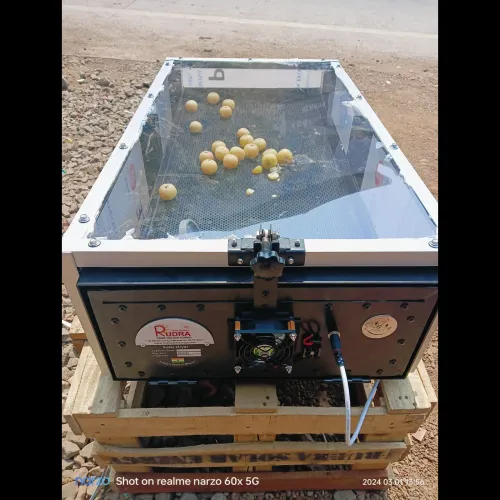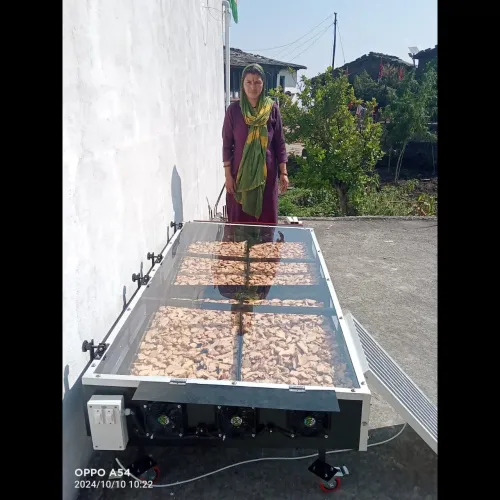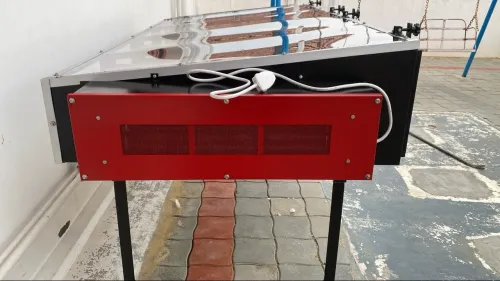
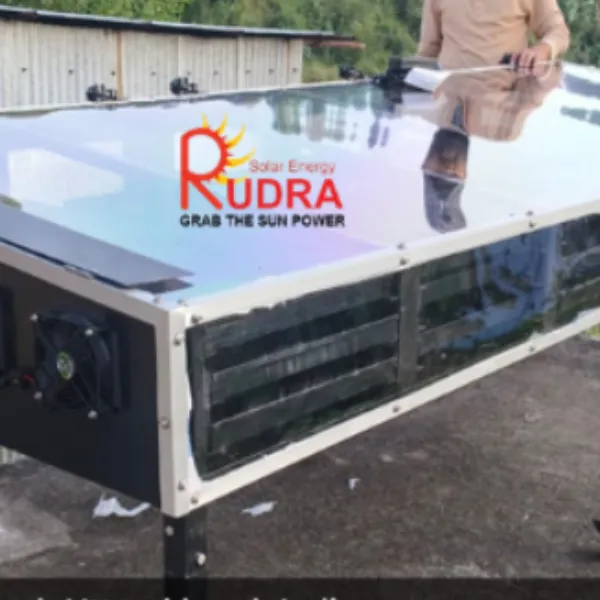
Fatehpur has a substantial agricultural base, with official district data showing cultivation across rice, wheat, pulses, oilseeds, maize and other crops. Alongside these field crops, district farmer records also document commercial cultivation of garlic, tomato, potato, kharif and rabi onion, giving Fatehpur a useful mix of commodities for post-harvest drying and value-addition applications.
For farmers, FPOs, SHGs and food-processing enterprises, an enclosed solar dryer in Fatehpur can support cleaner and more controlled moisture removal from prepared vegetables, spices, fruits and suitable agricultural produce. The correct dryer should be selected around the actual commodity, fresh batch quantity, tray area, airflow requirement and processing objective—not only a nominal kilogram rating.
Which products can be dried using a solar dryer in Fatehpur?
Depending on preparation and the required final product, suitable applications can include:
- garlic
- onion
- tomato
- potato
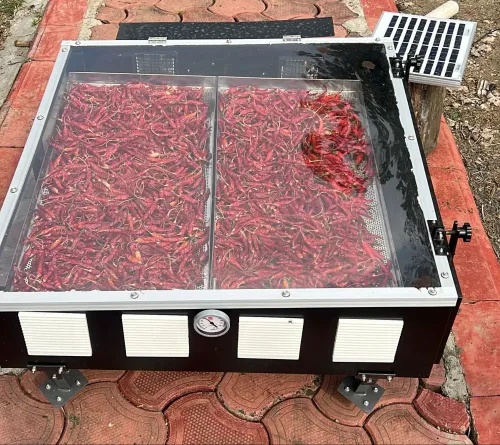
- chilli and selected spices
- coriander
- prepared fruits
- selected vegetables
- pulses
- grains and other compatible farm produce
Fatehpur’s official farmer profiles specifically document garlic, tomato, potato, onion and coriander cultivation, while the district agriculture programme also identifies pulses, oilseeds and maize among important crop groups.
Each commodity should still be treated as a separate drying application because moisture load, bulk density, preparation, tray depth and airflow requirements vary.
Is solar drying suitable for garlic in Fatehpur?
Yes. Garlic can be an important solar drying application where the intended product requires controlled moisture reduction.
An official Fatehpur farmer profile records commercial garlic cultivation, making garlic a particularly relevant local application rather than a generic crop example.
Depending on the final product, garlic may require cleaning, peeling, separation, slicing or other preparation before drying. The solar dryer performs the moisture-removal stage only and does not replace these preparation steps.
Can onion be dried in a solar dryer?
Yes. Properly prepared onion can be dried in an appropriately designed system.
Both kharif and rabi onion cultivation are documented in Fatehpur farmer records.
For onion drying, practical factors include:
- slice thickness
- initial moisture
- tray loading
- airflow distribution
- operating temperature
- relative humidity
- target final moisture
A deeper tray load is not automatically more productive, because restricted airflow can slow or unevenly affect moisture removal.
Can tomatoes be processed using solar drying in Fatehpur?
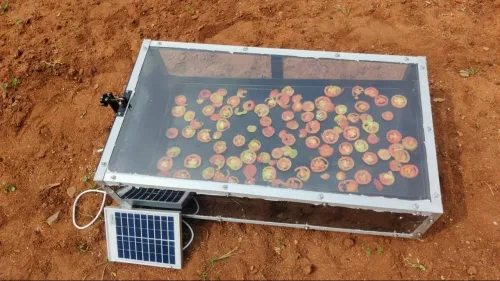
Yes. Prepared tomato slices or other suitable tomato forms can be dried, depending on the intended downstream product.
Tomato is specifically documented among commercially cultivated horticultural crops in Fatehpur.
Because fresh tomato contains significant moisture, drying performance depends heavily on product thickness, preparation, usable tray area, airflow and weather conditions. There should therefore be no universal claim that every tomato batch will dry within the same number of hours.
Is a solar dryer useful for potato processing?
It can be used for appropriately prepared potato products.
Potato cultivation is documented in multiple official Fatehpur farmer profiles.
Depending on the required dried product, operations such as washing, peeling, slicing and suitable pre-treatment may need to happen before loading. Drying should not be presented as a replacement for these separate processing stages.
Can fruits also be dried commercially in Fatehpur?
Yes. Fatehpur also has documented horticultural activity involving mango, guava, lemon and aonla, along with several other fruit species.
This creates additional opportunities for multi-commodity processors who handle vegetables during one season and suitable fruits during another.
Fruit drying should still be planned around the particular fruit, maturity, initial moisture, slice thickness and desired final product rather than applying the same conditions used for garlic or onion.
Can one solar dryer handle garlic, onion, tomato, potato and fruits?
A suitably designed multi-purpose solar dryer can process different compatible products in separate batches.
However, multi-purpose does not mean identical loading.
For example, the same 50 kg weight of two different commodities may require different:
- tray area
- product depth
- airflow
- drying temperature
- preparation
- processing duration
Strong-smelling products such as garlic and onion also require suitable cleaning and batch management before switching to another commodity.
What capacity solar dryer should a farmer or FPO choose in Fatehpur?
Capacity should start with the actual fresh material available per batch.
A farmer processing seasonal garlic or vegetables may need a different system from an FPO aggregating produce from several members.
Before finalizing capacity, evaluate:
- primary commodity
- fresh batch weight
- number of batches required
- crop season and harvest pattern
- slice or product thickness
- usable tray area
- airflow capacity
- daily processing target
- need for hybrid backup
A kilogram figure without information about usable drying area and commodity type is not enough to make a technically sound comparison.
Does a 50 kg solar dryer mean 50 kg of every crop can be loaded?
No. Nominal capacity should not be interpreted as universal crop loading.
Garlic, sliced tomato, onion, leafy produce and grains differ in bulk density, moisture content and tray-space requirement.
Therefore, dryer sizing should consider at least:
Product + Moisture Load + Tray Area + Airflow + Fresh Batch Quantity
This is more meaningful than selecting a machine only because its model name contains a particular kilogram figure.
How long does solar drying take in Fatehpur?
There is no single correct drying time for every commodity.
Actual duration varies according to:
- commodity
- initial moisture
- target final moisture
- product thickness
- preparation
- tray loading
- airflow
- solar radiation
- ambient temperature
- relative humidity
- dryer configuration
This means garlic, tomato and potato should not be advertised with one identical drying-time promise.
What temperature should be used for solar drying?
The appropriate operating temperature depends on the commodity and the final product requirement.
Some commercial solar drying systems may be capable of operating approximately within a 50–80°C range under suitable conditions, but this does not mean every product should be exposed to the maximum available temperature.
Product quality and moisture-removal behaviour should determine the operating approach.
Is a hybrid solar dryer useful for commercial processing in Fatehpur?
It can be useful when the processor needs greater continuity during periods of weak sunshine or less favourable weather.
A hybrid arrangement can supplement solar heat where required, but it does not eliminate the importance of:
- correct tray loading
- adequate airflow
- commodity-specific temperature
- initial and final moisture targets
- appropriate preparation
Hybrid should therefore be selected because the processing requirement justifies it, not simply as an additional feature.
What is the price of a solar dryer in Fatehpur?
Solar dryer price varies according to capacity, usable tray area, construction, airflow system, fan configuration, monitoring or controls, hybrid arrangement and customization.
For a more useful quotation, the buyer should provide:
Commodity + Fresh kg per Batch + Required Batches per Day + Location + Hybrid Requirement
For example, a processor handling sliced tomato may require a different configuration from one processing garlic or grains even when their daily fresh-material weight appears similar.
How should buyers choose a solar dryer manufacturer for Fatehpur?
Farmers, FPOs, SHGs and processors should compare systems on technical suitability rather than only the quoted price or kilogram rating.
Important questions include:
- Has the system been selected for my actual commodity?
- What is the usable tray area?
- How is airflow distributed?
- What construction and food-contact materials are used where applicable?
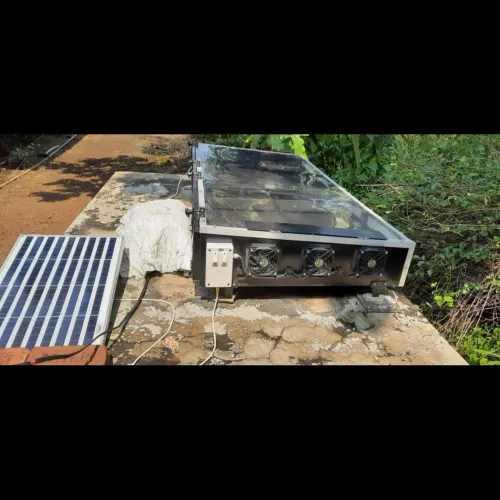
- Is forced airflow provided?
- What operating temperatures are realistically achievable?
- Is hybrid backup available if required?
- What installation and operator guidance is provided?
- Is after-sales support available?
- Are drying expectations explained with realistic commodity and weather limitations?
For Fatehpur, a system that is properly matched to garlic, onion, tomato, potato or the buyer’s actual crop mix will be more useful than choosing a generic dryer based only on advertised capacity.
Keywords