
Integrated Food Processing Solutions Pvt. Ltd.

Solar Dryer for Food Processing Industry | Multi-Product Dehydration Project
Solar Dryer for Food Processing Industry | Multi-Product Dehydration Project — main image
Solar Dryer for Food Processing Industry | Multi-Product Dehydration Project — image 2
Solar Dryer for Food Processing Industry | Multi-Product Dehydration Project — image 3
Customer:
Integrated Food Processing Solutions Pvt. Ltd.
Project Category:
Food Processing Industry
Customer Requirement:
The client required an enclosed solar food dryer capable of supporting different food products without depending on one fixed operating procedure. The processing unit needed flexibility for suitable batches of: fruits vegetables spices herbs selected agricultural ingredients seasonal value-added food products The client’s requirement was not limited to nominal dryer capacity. They needed a system that could be planned around the actual production workflow, including fresh input per batch, product dimensions, tray loading, daily batch schedule and operating season. Another important requirement was the ability to manage product changeovers. A food-processing unit switching from fruit to spice or vegetable batches needs different loading conditions and appropriate cleaning of food-contact surfaces between products. The client also wanted the option to evaluate backup-assisted operation where production schedules could not depend only on favourable solar conditions.
Project Result:
The project established a structured solar dehydration stage within the client’s food-processing workflow. The key outcome was not simply the ability to place multiple foods inside one dryer. The processing unit gained a framework for handling different suitable products through separate batch settings based on commodity, preparation, tray loading, airflow and final moisture requirement. This made the system useful for a processing business whose product mix changes across seasons. For example: Fruit batch: emphasis on slice consistency and high-moisture removal. Vegetable batch: emphasis on preparation, loading density and airflow. Spice batch: emphasis on product-specific temperature and moisture management. Herb batch: emphasis on lighter loading and suitable airflow. The project therefore demonstrates how an industrial solar food dryer can be integrated as one part of a larger processing line without incorrectly treating drying as washing, slicing, grinding, sterilizing, packaging or storage. For future capacity planning, the client can evaluate a new product using practical questions such as: What is the fresh input per batch? How much usable tray area is required? What form will the product enter the dryer in? How much airflow can pass through the loaded trays? What final moisture condition is required? How many batches must be completed in the available production window? That gives the project stronger relevance for food-processing MSMEs, commercial processors, FPO processing centres, institutional processing units and value-addition enterprises looking beyond basic household-scale dehydration.
What we did:
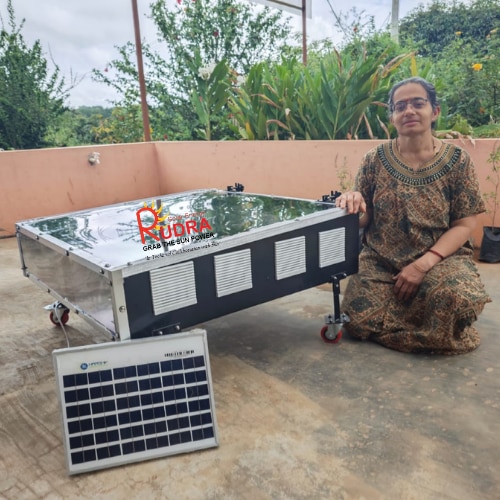
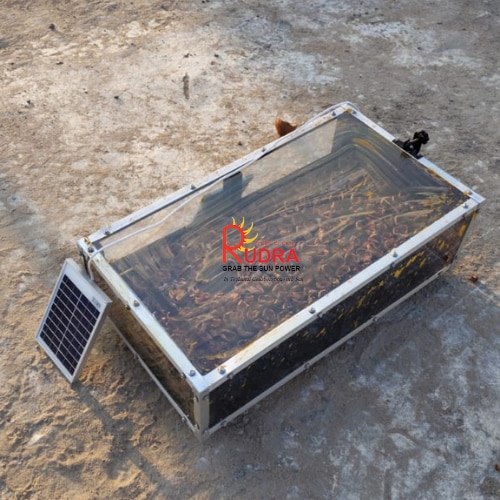
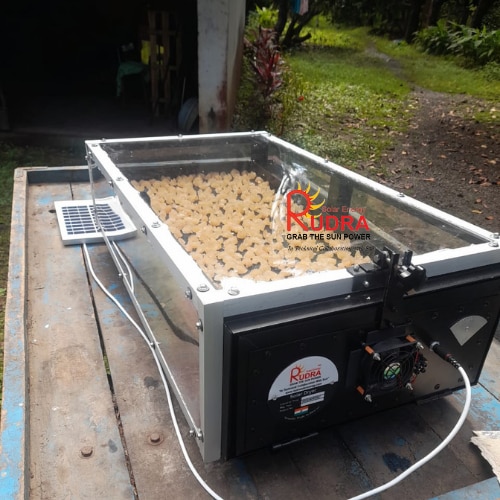
Rudra Solar Energy designed the project around the client’s multi-product food-processing cycle. Instead of using one universal drying schedule, the system and operating approach were organised around each product’s physical and moisture characteristics. The workflow was structured as: Raw Material Preparation → Batch Identification → Controlled Tray Loading → Solar-Assisted Drying → Airflow Management → Moisture Endpoint Assessment → Cooling → Next Processing Stage Particular attention was given to usable tray area. For sliced fruits and vegetables, consistent product thickness and controlled loading help expose more product surface to moving air. For spices or lightweight herbs, tray depth and airflow need to be reconsidered because their bulk behaviour differs from high-moisture fruit pieces. The project approach included: assessment of the main product categories; planning fresh-input quantity per batch; organising usable tray area and tray loading; configuring enclosed drying conditions; supporting controlled or forced airflow where applicable; planning humid-air removal from the drying chamber; considering temperature and moisture monitoring; establishing product-changeover practices; evaluating solar-only versus optional hybrid/backup operation according to production needs. Rudra’s current product ecosystem includes solar and hybrid drying configurations for commercial food-processing applications, although exact construction, materials and specifications depend on the selected model.

Project Description

Rudra Solar Energy developed a solar dryer for food processing industry applications for a processing unit handling multiple food commodities across different production cycles. Food-processing businesses often work with products that behave very differently during dehydration. Fruits may contain high initial moisture, vegetables may require controlled slicing and tray distribution, spices can need different temperature management, and herbs may require comparatively gentle airflow because of their lightweight structure. For this project, the solar drying system was therefore planned as a multi-product dehydration platform rather than a fixed single-commodity dryer. The project focused on five practical processing factors: batch quantity, usable tray area, product preparation, airflow distribution and required moisture endpoint. This approach allows the drying stage to be integrated into a broader food-processing workflow while keeping preparation, drying, cooling, grinding, packaging and storage as clearly separate operations.