
Integrated Livestock Feed Processing Enterprise

Rudra Solar Feed Dryer for Fodder & Animal Feed Ingredient Processing
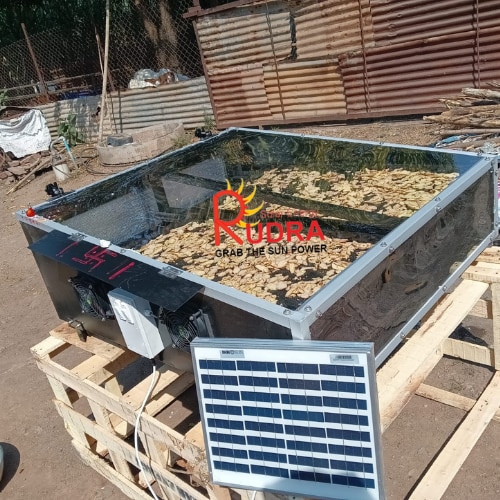
Rudra Solar Feed Dryer for Fodder & Animal Feed Ingredient Processing — main image
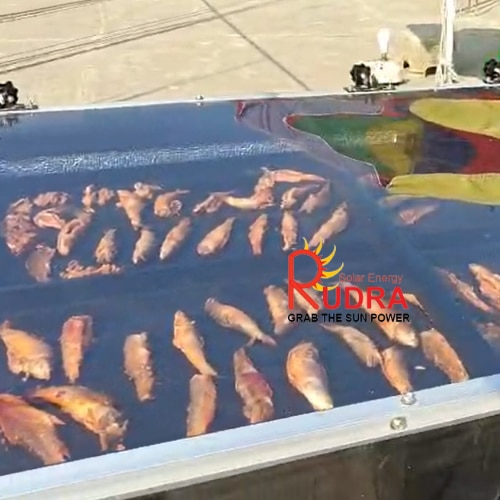
Rudra Solar Feed Dryer for Fodder & Animal Feed Ingredient Processing — image 2
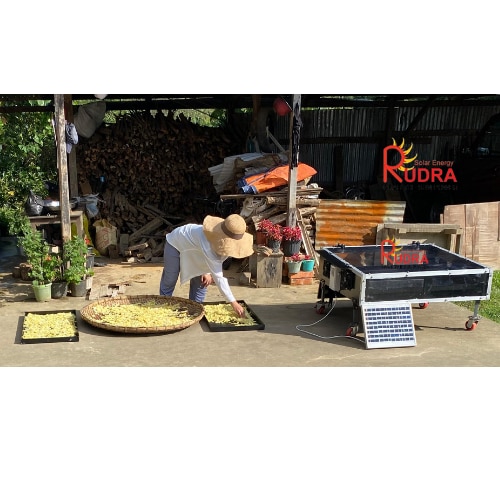
Rudra Solar Feed Dryer for Fodder & Animal Feed Ingredient Processing — image 3
Customer:
Integrated Livestock Feed Processing Enterprise
Project Category:
Animal Feed & Fodder Processing Industry
Customer Requirement:
The client handled several agricultural materials intended for animal-feed applications and needed a more organised moisture-reduction stage before selected batches entered storage, milling, blending or other downstream operations. The processing requirement included suitable materials such as: Chopped fodder material Selected dried leaves and botanical feed ingredients Azolla intended for dried-feed applications Grain-based feed ingredients Compatible agricultural by-products Selected feed raw materials requiring moisture reduction ICAR has documented the use of dried Azolla as an animal-feed supplement, while NDDB also recognises drying as part of hay and fodder handling. The client required the system to address four practical challenges: Different incoming moisture levels — freshly harvested or wet material could not be treated like already partly dried feed ingredients. Variation in bulk density — leafy material occupies tray area differently from grain-based ingredients. Airflow through the product — thick or compact loading can make moisture removal less uniform. Batch separation — different feed ingredients needed to remain identifiable instead of being processed as one mixed material. The processor also wanted the drying stage clearly separated from feed formulation. Grinding, ration formulation, mixing, pelleting, supplementation and packaging are separate processes and were not treated as functions of the solar dryer.
Project Result:
The project established a dedicated solar feed-drying stage for suitable animal-feed and fodder ingredients instead of relying entirely on uncontrolled open exposure for selected batches. The processor gained a more structured method for deciding how each material should enter the drying system. Rather than using one fixed setting, batches could be assessed through: Feed Ingredient ↓ Incoming Moisture ↓ Physical Form ↓ Loading Depth ↓ Airflow Requirement ↓ Required Final Moisture ↓ Storage or Further Processing This distinction was especially useful when the facility shifted between lightweight leafy materials and denser grain-based ingredients. The project also helped establish a technically clearer boundary between: dry fodder processing, feed-ingredient moisture reduction and silage production. That makes the solution relevant to commercial users such as: Animal-feed processing businesses Dairy and livestock enterprises FPOs and agricultural cooperatives Fodder-processing centres Feed ingredient suppliers Rural livestock-development projects Poultry and livestock feed enterprises Agricultural by-product processors The solar dryer should not be viewed as a system that automatically makes a material nutritionally suitable or safe for animal consumption. Feed suitability, formulation, ingredient quality and applicable feed standards must be evaluated independently. The role of the dryer is specifically to provide an organised moisture-reduction process for suitable feed raw materials.
What we did:
Rudra Solar Energy designed the processing approach around the raw feed ingredient rather than a generic kilogram capacity. 1. Feed Materials Were Classified Before Processing The workflow first divided suitable materials according to their physical form: Leafy / lightweight material such as selected dried-feed leaves or suitable botanical ingredients. Chopped fodder material where piece size and loading depth influence air movement. Grain-based ingredients where bulk density and grain-bed depth become important. High-moisture raw materials which may require preparation or preliminary dewatering before solar drying is technically appropriate. ICAR has reported that high-moisture spent grain can benefit from mechanical moisture removal before subsequent drying, illustrating why very wet feed ingredients may require a pre-drying step rather than simply being loaded directly into a dryer. 2. Loading Depth Was Matched to the Material The project avoided treating dryer capacity only as: “maximum kilograms that can be placed inside.” For animal-feed materials, the distribution of the product matters. A lightweight leafy ingredient can occupy a large tray area at relatively low weight, while grain-based material may create a denser bed. Excessive layer depth can restrict air movement. The loading approach was therefore based on: ingredient type → particle or piece size → tray area → layer depth → airflow requirement. 3. Moisture-Laden Air Needed a Clear Exit Path A solar dryer does more than create a warm chamber. As moisture moves from the feed ingredient into the surrounding air, that air becomes increasingly humid. Effective drying therefore depends on both: thermal energy + movement of moisture-laden air. The project emphasised organised airflow across the loaded material so released moisture could be carried away rather than remaining concentrated around the product. 4. Drying Conditions Were Kept Ingredient-Specific No universal drying temperature or time was prescribed for all animal-feed materials. Instead, operators were instructed to consider: initial moisture condition material type particle or cut size loading depth airflow ambient humidity operating temperature required final moisture intended downstream use FAO feed guidance also distinguishes dry, moist and wet feed systems, reinforcing that feed materials should not all be pushed toward one arbitrary moisture level. 5. Hay-Type Drying Was Kept Separate from Silage This distinction was particularly important for technical accuracy. Dry fodder/hay relies on moisture removal before suitable storage. Silage, in contrast, is preserved as intentionally high-moisture forage under controlled anaerobic conditions. NDDB guidance describes silage as preserved green fodder with high moisture, while well-dried fodder or hay is handled through a different storage process. For this reason, the project did not market the solar dryer as a substitute for silage-making systems. 6. The Dryer Was Integrated Before Downstream Feed Processing The planned workflow was: Raw Feed Ingredient → Sorting / Required Preparation → Moisture Assessment → Controlled Tray Loading → Solar-Assisted Drying → Final Moisture Assessment → Cooling → Storage or Further Feed Processing Depending on the client’s operation, subsequent stages could include: grinding, mixing, formulation, pelleting or packaging. These were treated as independent operations.

Project Description

An animal-feed processing enterprise required a dedicated solar dryer for animal feed ingredients to manage moisture in selected fodder materials, leafy feed ingredients and compatible agro-based raw materials before storage or further feed processing. Unlike conventional food dehydration, animal-feed processing can involve materials with very different structures and moisture conditions. Chopped fodder, leafy biomass, grain-based ingredients and high-moisture agro-industrial materials cannot automatically be loaded or dried using the same operating conditions. The project was therefore planned around ingredient identification, controlled loading, airflow, moisture assessment and the intended next processing stage. The objective was not to dry every feed material indiscriminately. Instead, the system was configured for suitable feed ingredients where controlled moisture reduction formed a defined part of the processor’s workflow. FAO guidance identifies excessive moisture as an important storage concern for feedstuffs because moisture conditions influence susceptibility to fungal growth and deterioration. The appropriate final moisture, however, depends on the particular feed ingredient and how it will subsequently be stored or processed.